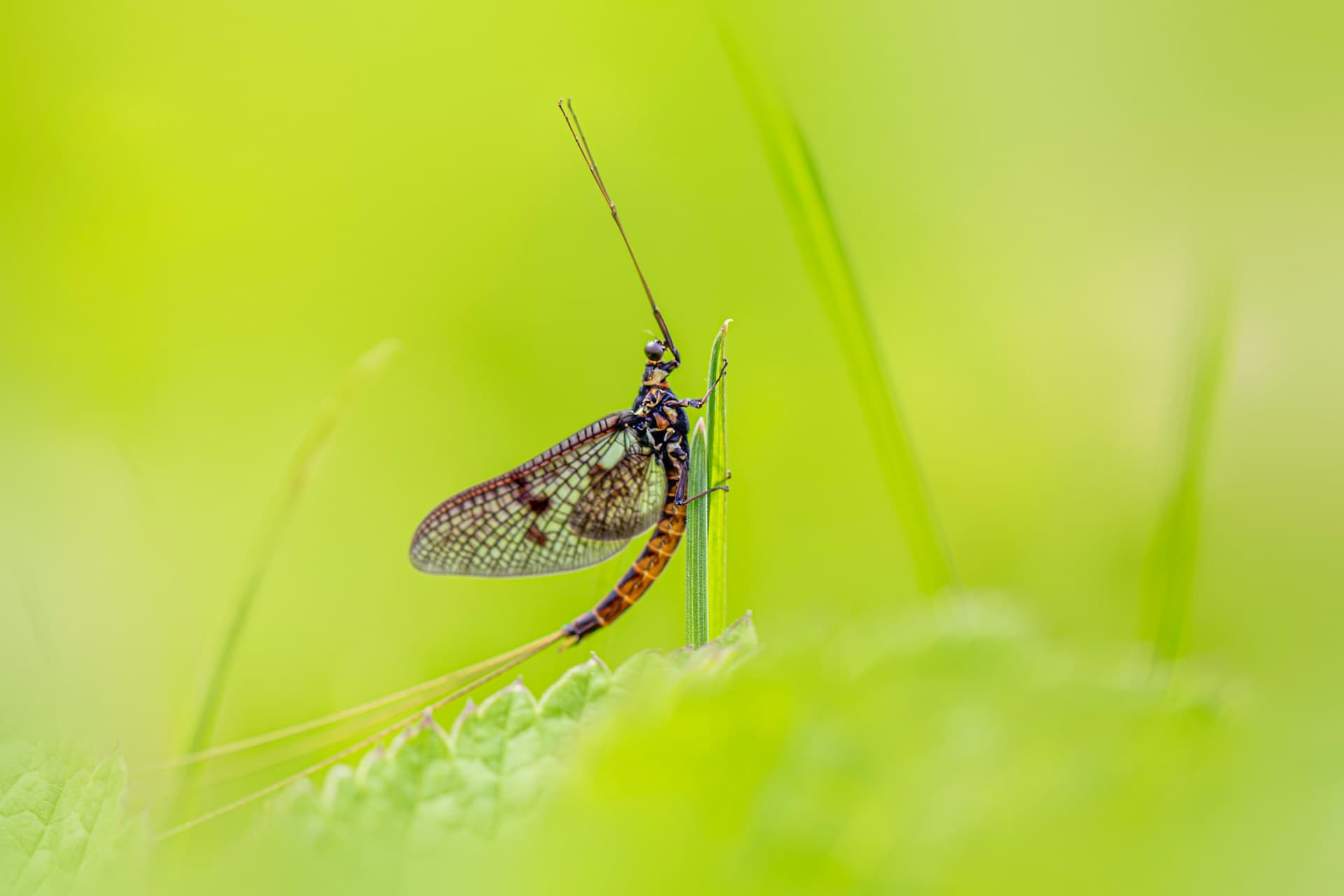
Three Hundred and Fifty Million Years in the Air
Long before dinosaurs, before dragonflies, before anything with wings lived on Earth, mayflies were hatching from rivers.
Long before dinosaurs, before dragonflies, before anything with wings lived on Earth, mayflies were hatching from rivers. They appeared in the Carboniferous period — 350 million years ago — when the continents were assembling themselves in peculiar arrangements and the air was thick with oxygen. Their wings have never changed much since. If you could hold a Baetis rhodani next to a fossil imprint from that era, you would see cousins separated by longer geological time than separates us from Tyrannosaurus rex.
This stability is remarkable. While the world cycled through ice ages, asteroid strikes, and the slow continental drift that rearranged mountains and seas, mayflies kept hatching. They were there when the first fish crawled onto land. They were there when those fish became amphibians, and when amphibians became reptiles, and when reptiles became something with fur and eventually something that could make coffee. We are, in a way, temporary visitors at a mayfly hatch that started before we learned to walk upright.
The Insect That Moults After Growing Wings
Mayflies are the only insects in the world that moult after their wings are fully formed.
Mayflies are unique among all insects in a way that seems almost embarrassing — they moult after their wings are fully formed and ready to fly. The nymph, having spent months or years underwater, sheds its skin at the water's surface and becomes the dun, or subimago. The wings are fully formed. The fly can fly. And yet it is not finished. Within hours, sometimes just minutes, the dun climbs onto a leaf or a reed stem and moults again — a final sloughing of the skin to become the spinner, the fully adult insect.
It is as if you were to graduate from university, put on your robes and mortarboard, give a speech, shake hands with the chancellor — and then, before dinner, take the whole thing off again and go through graduation a second time. For mayflies, this second moult is not optional. The spinner stage is when mating happens, when eggs are laid, when the cycle completes itself. The dun is a sort of understudy, dressed for the role but waiting in the wings for the real thing.
To the angler, this matters enormously. The dun and the spinner are different insects — different silhouettes, different sitting positions, different behaviours on the water. A mayfly hatch is really two hatches separated by a few hours and a moult. Understanding this distinction has cost anglers untold hours of frustration, and revealed to patient observers some of the best fishing of the year.
The Mouth That Cannot Eat
The adult mayfly has no functional mouth. It cannot feed. It can only mate, lay eggs, and die.
Here is something that should make you slightly unsettled: the adult mayfly has no mouth. Not a small mouth. Not a mouth that's a bit out of proportion. No mouth at all. The species name Ephemera, from which we get “ephemeral,” means lasting only a day or two — and that is exactly right. The dun emerges from the water with fully formed but non-functional mouthparts. The spinner, that final form, has mouthparts so reduced that they are little more than vestigial decoration. It cannot eat. It cannot drink. Its entire reason for existence, from the moment it sheds its skin for the final time, is to mate, lay eggs, and die.
This is both horrifying and rather poetic. An insect that has spent a year or more underwater as a nymph — feeding, growing, building towards this moment — emerges into air and light, has perhaps a day, perhaps only a few hours, to find a mate, produce offspring, and then simply cease to be. The spinner will spend an evening dancing above the water with thousands of its siblings, forming swarms in the golden light of dusk, before returning to the surface to lay eggs and fall spent — a food item so obvious and so numerous that even the laziest trout will rise to them.
Turban Eyes
Male mayfly eyes fuse at the top of the head, looking upward — built to spot females against the sky.
Male mayflies have evolved a particular arrangement of the eyes that would be comical if it were not so clearly purposeful. The compound eyes meet at the top of the head — fused together or nearly so, forming what looks like a turban or a cap. The female's eyes remain separated on the sides of the head like a normal insect. This is the spinner, the fully adult form, and the male needs to see upward to locate females in the swarm.
The swarm itself is one of the great sights on a river: hundreds or thousands of spinners dancing in the golden light of an evening, males rising and falling in columns of air, watching the female spinners with those extraordinary turban eyes. The females enter the swarm briefly, mate almost instantly — if they can avoid the predatory attention of every swallow and wagtail in the parish — and then return to the water to lay their eggs. The males that fail to mate will die without issue, their extraordinary eyes having failed to spot a female in the chaos of the swarm. One suspects they know the feeling.
Four Designs for Living Underwater
Every mayfly nymph is built for a specific job in its specific river. The body shape tells you everything.
The mayfly nymph comes in four basic body types, each one perfectly engineered for a different way of life in the river. The Green Drake nymph (Ephemera danica) is a burrower — soft, cylindrical, it digs U-shaped tunnels in the silt and fine sand of slower rivers and lake margins. The March Brown nymph (Rhithrogena germanica) is a stone-clinger, flattened dorsally like a limpet, gripping the undersides of rocks in fast, turbulent water where anything less committed would be swept away. The Large Dark Olive (Baetis rhodani) is a swimmer with a sleeker, more streamlined body, able to dart through moderate flows with agile flicks. And then there are the crawlers — tiny Caenis and their kind — bottom-dwelling, working through fine detritus in slow water.
Each type has evolved to exploit a different part of the river. The burrower needs silt. The stone-clinger needs fast water and clean rock. The swimmer needs moderate flow over gravel. The crawler works the fine silts where almost nothing else can survive. This is why some rivers have certain mayflies and not others — a fast rocky river cannot support Green Drake nymphs because there is no silt to burrow in, and a slow lowland stream cannot hold March Browns because the water is too languid and the substrate too soft.
For the angler, this is practical intelligence. If you can see the riverbed, you can read the nymphs it supports. Clean gravel with moderate flow: expect olives. Boulders and fast broken water: expect March Browns. Silty bends and lake margins: expect Green Drakes. The river itself tells you what will hatch, if you look.
The Spinner Fall
Thousands of spent mayflies, wings outstretched, riding the current downstream. The easiest meal a trout will have all year.
The spinner fall is one of the most extraordinary sights in fly fishing: thousands of mayflies returning to the water after their brief moment in the swarm, spent, their wings outstretched flat on the surface, riding the current downstream like tiny derelict sailboats. The trout know this moment. It is the easiest meal they will have all season — food so abundant, so helpless, that even a fish that has refused your fly all afternoon will rise repeatedly until it is gorged.
The spinners that created the swarm — the females that mated and need to lay eggs — return to the water where they hatched. They hover over the surface, dipping their abdomens to release eggs into the flow. The males return exhausted, their purpose fulfilled or not. All of them, whether they mated or not, are dying. Within minutes of touching the water, most are dead or nearly so, their wings still outspread, tumbling downstream in the current.
This is what the angler waits for. This is what brings the dry-fly fisher to the riverbank at dusk with a Sherry Spinner in size 14 and the quiet certainty that if anything can tempt the biggest trout in the pool, it will be this. The trout will be rising steadily, rhythmically, without the caution they show to a scattered hatch. In a spinner fall, the fish know the food is going nowhere and there is plenty of it. Your fly simply needs to be among it.
The Duffer’s Fortnight
For two weeks in late May, the Green Drake hatches in such numbers that even a moderate angler can catch fish. Hence the name.
The Duffer's Fortnight is a miracle of timing and abundance. For roughly two weeks in late May and early June, the Green Drake (Ephemera danica) hatches on Irish limestone loughs and English chalk streams in such numbers that the surface becomes covered with emerging duns and spent spinners. These are big flies — hook size 10 or 12 — and they arrive in a synchronised mass emergence triggered by water temperature crossing the 14–15°C threshold. The legend says that even a duffer can catch fish during this period. Hence the name.
The term comes from the English chalk streams, particularly the Test and Itchen, where the Mayfly has been celebrated in fly-fishing literature for two centuries. Halford fished the Mayfly hatch. Skues watched it. Goddard wrote about it. For many chalk-stream anglers, this brief window defines the season. The trout are gorged. The water is alive with huge insects. The fishing can be spectacular, or it can be surprisingly difficult if the hatch is so heavy that the fish are overwhelmed with choice and your imitation is one fly among ten thousand naturals.
On Irish limestone loughs — Corrib, Mask, Sheelin — the Mayfly hatch brings the season to life. Boats put out from the shore. The water boils with rising trout. The duns hatch in waves, and the spinners fall at dusk in thick clouds. A fortunate angler in the right place at the right time might see rises for four hours straight, each rise a fish taking another huge green fly off the surface. It is, by any measure, one of the great events of the European fishing year.
The Invention of the Dry Fly
In the 1880s, an angler named Halford watched mayflies hatch on the Test and changed fly fishing forever.
For most of fly-fishing history, anglers fished wet flies — sunken patterns presented subsurface, often with a downstream cast and a swing controlled by the current. It was a perfectly functional way to fish. It caught trout. It worked on rivers across Europe. But in the 1880s, a chalk-stream angler named Frederick Halford began to watch the mayfly hatch on the Test, and he observed something that changed everything: the trout were rising to the duns floating on the surface, and they were ignoring the same flies fished beneath it.
Halford's insight was radical. If the trout were taking duns, then the angler should present a fly that floated like a dun, that sat on the surface with upright wings, that looked like a dun to a fish staring up at it against the light. He designed dry flies and fished them with a dead-drift presentation, letting the current carry the fly without any action from the rod. The result was devastatingly effective.
He published Floating Flies and How to Dress Them in 1886, and it launched a revolution. The upstream cast, the delicate presentation, the exact matching of size and colour to the natural insect — these became the defining techniques of chalk-stream fishing and eventually spread to every trout river in the world. The entire dry-fly tradition, the most celebrated branch of fly fishing, was built on a man watching mayflies hatch and asking himself what the trout actually saw.
Matching the Moment: Nymph, Emerger, Dun, Spinner
The mayfly lifecycle gives you four distinct fly patterns and four distinct fishing moments. Read the water and you will know which.
The nymph is available year-round, especially in the weeks before the hatch when the nymphs are most active. Fish a Pheasant Tail Nymph or Perdigon in size 14–16 on a tight line or under an indicator, dead-drifted through the zones where nymphs live: underside of rocks for stone-clingers like March Brown, silty bends for Green Drake, moderate gravel runs for the olives. Weight the fly appropriately. The nymph is always in the water, always available, and always worth trying when you see no rises.
The emerger stage is the most vulnerable moment in the lifecycle — the nymph ascending through the water column, shedding its shuck at the surface, trapped in the film while the wings unfurl. A Klinkhamer or CDC emerger pattern fished in the film is often more effective than a dry fly during the early stages of a hatch. Watch for fish that show their backs but not their heads — they are taking emergers just below the surface, not duns on top of it.
When the duns are up, switch to a CDC dry fly or conventional hackled pattern in the appropriate colour and size. For Large Dark Olive (Baetis rhodani): size 14–16, olive. For March Brown (Rhithrogena germanica): size 12, mottled brown. For Blue-Winged Olive (Serratella ignita): size 14–16, olive with rusty tones. For Green Drake (Ephemera danica): size 10–12, greenish yellow. Dead drift, upstream of the rising fish, with a drag-free float through the feed lane.
The spinner fall is evening fishing and often the best of the day. Spent spinners lie flat on the surface with wings outstretched. Fish a Sherry Spinner or spent pattern in the appropriate size with a dead drift. The spinner fall creates a feeding rhythm that can last from dusk until dark. Fish will be rising steadily and predictably. This is not the time to experiment — find the depth, find the drift line, match the size, and let the river do the work.
The Mayfly Year
Different mayflies hatch at different times, governed by water temperature and the accumulated warmth of the season.
The Large Dark Olive (Baetis rhodani) is the hardiest mayfly on British and European rivers, hatching as soon as the water reaches 5°C. It appears in February or March and peaks around 10°C. There is a spring brood and a distinct autumn brood from September to November, when the second generation hatches on falling temperatures and shortening days. The Iron Blue (Baetis niger) prefers cold, blustery weather — a 7°C trigger and a maximum of 14°C. It hatches on overcast, windy afternoons when other insects have given up. Watching the Iron Blue come off during foul weather is one of those quiet gifts the river gives to patient anglers.
The March Brown (Rhithrogena germanica) hatches in spring when the water reaches 8°C, peaking at 11°C. It is the defining hatch of northern English rivers, Welsh border streams, and Cantabrian spate rivers. The Blue-Winged Olive (Serratella ignita) waits for warmer water — 10°C trigger, peaking at 14°C — and is the great summer and autumn evening fly, hatching from late afternoon onwards. Its spinner fall in the sherry-coloured dusk is famous across the chalk streams and freestone rivers of western Europe.
The Green Drake (Ephemera danica) needs the warmest water: a 10°C trigger but peaking at 15°C. This is a late spring and early summer hatch, concentrated in a two- or three-week window. The Yellow May Dun (Heptagenia sulphurea) is a stone-clinger hatching slightly later, from May onwards, in the same fast-water habitat as the March Brown. Understanding these timing windows is the first step toward matching the hatch: arrive on the river when the water temperature and the calendar agree, and you will be ready for whatever comes off the water.