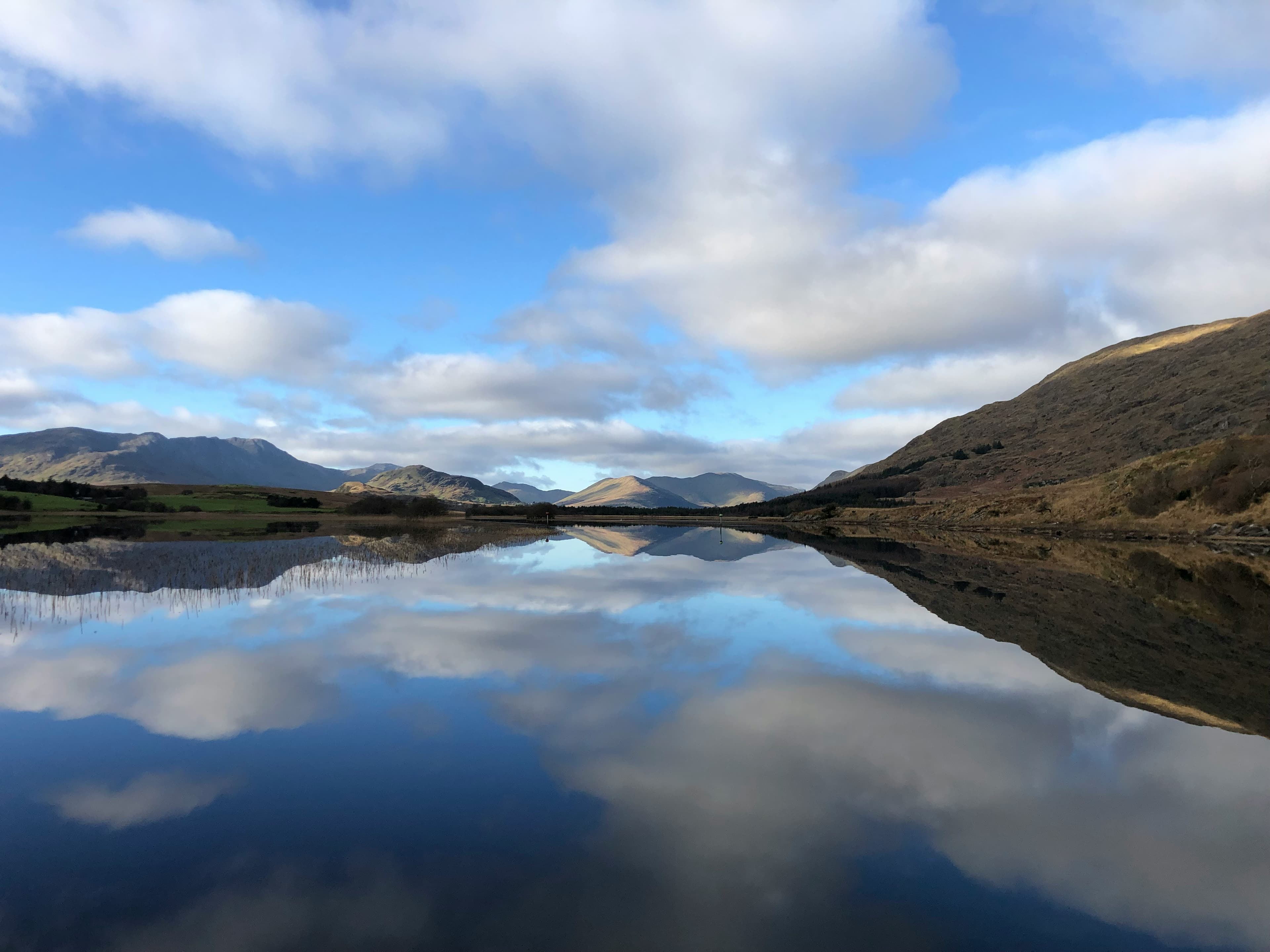
A Different Country Entirely
These are not reservoirs. They are ancient, wind-swept inland seas where wild brown trout have been doing this longer than we have.
Ireland's western loughs — Corrib, Mask, Derg, Conn, Carra — are not reservoirs. Nobody dammed a valley, stocked it with rainbows, and called it a fishery. These are ancient limestone lakes, wind-swept and enormous, where wild brown trout feed on shrimp drifts and mayfly hordes with a confidence that comes from never having seen a pellet in their lives. The fishing here predates anything English stillwater culture has produced, and it shows.
Forget the manicured English reservoir grind — the numbered platforms, the competition anglers with their tackle trolleys, the stocking lorry on Tuesday mornings. On an Irish lough, you are at the mercy of Atlantic gales, thirteen-foot dapping poles, and fish that sip duns like gentlemen or slash bumbles like pirates. The banks are often inaccessible — rock walls, bog, reed beds that would swallow a wading boot and most of the angler attached to it. The fishing happens from boats, driven by wind, and it has been happening this way for centuries.
This is lough-style fishing: boat-based, wind-driven, and gloriously, unapologetically Irish. The biology drives it. Wild browns cruise the shallows — three to eight feet over limestone rock — chasing freshwater shrimp, buzzers, and hog lice year-round. When the mayfly hatches between May and June, the loughs erupt into something close to pandemonium, with clouds of duns sailing downwind and trout rising everywhere the eye can see. Wind piles food against islands and submerged reefs, and the fish stack there like commuters at a bus stop, except with better manners.
Wet Fly: The Heart of Lough Fishing
A team of three or four flies, drifting downwind over the shallows. This is eighty per cent of your day, and all of it matters.
Wet fly accounts for eighty per cent of the fishing on Irish loughs. The method is straightforward. A team of three or four flies on a floating line, cast ahead of a drifting boat, retrieved through the wave as the boat follows. Point fly at the end — typically an attractor or a larger pattern that searches the water. Middle and upper droppers carry naturals: olives, bumbles, dabblers that match the food in the shallows. The bob fly, on the top dropper, is the dibbler — a bushy pattern that skates and bobs in the surface film, pulling fish up from depth.
Early season, February through April, the shrimp and hog lice are the primary food. Fish the rocky shallows with dabblers and shrimp patterns — Doc's Fiery Brown, Cock Robin — on a slow figure-of-eight retrieve. The trout are gorging on crustaceans in three to six feet of water over limestone rubble, and a fly that suggests a shrimp tumbling in the current will take fish when nothing else is moving.
Pre-mayfly, as the water warms into late April and May, shift to Golden Olive Bumbles and Sooty Olives on the droppers, with a bushy bob fly dibbled in the surface. The retrieve is slow — figure-of-eight with pauses — and the take often comes as a lift. The fish turns on the fly and you feel the weight. Do not strip-strike. Lift the rod into the fish. A single drift can cover a hundred metres of productive water.
Dapping: Mayfly Magic
A thirteen-foot pole, a blowline, two live mayflies, and the kind of take that ruins you for other fishing.
There is nothing in fly fishing quite like dapping on an Irish lough during the mayfly. The method is ancient and absurdly simple: a thirteen-foot pole, a length of blowline that the wind catches and carries, and at the end two live mayflies hooked through the thorax. The wind lifts the blowline and dances the naturals ten to twenty feet ahead of the drifting boat, skating and twitching across the wave. When a trout takes — and the takes are splashy, violent, heart-stopping — the whole lough seems to pause for a moment before the chaos begins.
The mayfly hatch moves westward through the lough system. Derg fires first, typically around the twelfth of May, then Corrib and Mask follow. Cloudy, windy days are best — the duns sail downwind in their thousands, and the trout lose what little caution they possess. On a still, bright day the hatch fizzles and the fish stay deep. You need weather, and on an Irish lough in May, weather is rarely in short supply.
When live mayfly are not available or the hatch is spent, fish dry flies — Wolfhound sedges, spent spinners, CDC emergers — on short casts ahead of the boat. In early season before the mayfly arrives, buzzer pupae and lake olives fished dead-drift under an indicator produce when the wet fly is quiet. But make no mistake: the dapping is why people come. It is the thing itself.
Reading the Lough: Where Wild Browns Live
Islands, reefs, shallows invisible until you are on them — and the gulls that show you where the fish are.
Irish loughs have geography that would defeat a chart. Submerged reefs, rocky shallows, islands by the dozen, weed beds that appear and vanish with the seasons. The fish know all of it. You learn it over years, or you hire a ghillie who already has.
The shallows and rocky ground — three to ten feet over limestone — are the shrimp factories. Early season, this is where the fishing lives. Windward drifts concentrate food against points and island edges, creating the same food highways that work on English reservoirs but with wilder, more varied structure. During the mayfly, the lanes narrow to one to three feet over weed, where spent spinners collect in the evenings and the trout feed with the single-mindedness of fish that know the feast is temporary.
On Corrib, the Illaunmore shallows and the Moycullen drifts are legendary. On Mask, the island points and Carra outflows hold fish through the season. On Derg, the early mayfly draws anglers from across Europe to drifts that have been fished for generations. But the honest truth of lough fishing is that the hotspots change with the wind. A drift that produced twenty fish yesterday may be dead today because the wind has shifted and the food is elsewhere. Watch where the gulls are feeding. They are on the same buzzers as the trout, and they are easier to see.
Seasons: Hatches and Waves
February shrimp, May mayfly, July daddies, September spinners — the lough year has its own calendar.
The lough season opens in February with a rawness that sorts the committed from the curious. Water temperatures are barely above single figures, the wind has an Atlantic edge, and the trout are feeding deep on shrimp and hog lice over rocky shallows. Wet bumbles and dabblers fished slow and deep, with the boat controlled carefully over known ground. This is honest, cold, rewarding fishing for anglers who understand that the lough gives nothing easily in winter.
May and June belong to the mayfly. The Greene Drake hatch is the defining event of the Irish angling year — clouds of large duns sailing downwind, trout rising everywhere, dapping poles bending, and a general air of barely contained excitement that infects even the most measured anglers. Dapping and dry fly dominate. Fish the windward drifts over weed in one to three feet of water where the spinners collect.
July and August bring daddies and sedges. The dapping shifts from mayfly to crane flies and large sedge patterns, and the wet fly team earns its keep again on breezy days when the wave is running. September closes the season with spent spinners fished dry over islands in the evening, and nymphs through the day as the water cools and the trout feed up for winter.
One weather rule governs everything: a south-westerly gale is the lough angler's friend. It drives food, creates wave, gives the trout confidence, and produces the kind of drifts that end with twenty fish and stories told until midnight. An east wind is the enemy — flat, cold, fishless. On an east-wind day, consider the pub.
Flies: The Irish Classics
Kingsmill Moore's originals still work because the biology has not changed. Nor should the fly box.
The Irish lough fly box is rooted in tradition because the tradition is rooted in biology. T.C. Kingsmill Moore's patterns — described in his 1960 masterwork — were designed around the food that wild browns eat in limestone loughs: shrimp, olives, sedges, mayfly. They work because they match the food, not because they are old.
The wet-fly team builds around a core set. On the point: Doc's Cock Robin or a Golden Olive Bumble — patterns with enough presence to search the water and attract attention from depth. On the droppers: Sooty Olive, Fiery Brown Dabbler for the shrimp-rich early season, shifting to olive and claret bumbles as the hatches develop. The bob fly is the bushy dibbler — a Bibio, a Claret Bumble tied full, or a Green Peter — anything that will skate and disturbance the surface to pull fish up.
For dapping: live mayfly when available, hooked in pairs through the thorax. When the natural hatch is over, sedge hogs and daddy-longlegs tied on size 8 or 10 hooks. Modern additions include micro zonkers for early-season lure work when the trout are deep and aggressive — a concession to contemporary practice that Kingsmill Moore would probably have approved of, provided it caught fish.
Boat Craft and Tackle
A shared currach, a drogue, a floating line, and the discipline to lift into takes rather than strip.
The boat is a currach or a fibreglass pram, shared between two or three anglers. One fishes the bow, one amidships, the third (if present) manages the drogue and fishes when the drift allows. Drift speed is controlled by the drogue or moke — one to two miles per hour is ideal. Faster than that and the flies fish too shallow; slower and you lose the wave action that brings the bob fly to life.
Rod: ten to eleven feet, rated six or seven weight for the wet fly. A thirteen-foot dapping pole for the mayfly season, though not every angler carries one — the dapping is often a specialist pursuit with its own tackle. Line: floating only. Irish lough-style fishing does not require sinking lines. The flies fish in the top three to six feet, and the floating line with a nine-to-twelve-foot tapered leader puts them there.
The critical difference from English reservoir fishing: do not reel into takes. Lift the rod. The wet fly is fished on a relatively short line — ten to fifteen yards — and the take comes as a tightening or a pull during the retrieve. Lift the rod tip firmly and the hook sets. Strip-striking, the reflex of the reservoir angler, pulls the fly away from the fish's mouth at the wrong angle. On an Irish lough, the lift is everything.
Takes and Educated Fish
Wild browns sip subtly on the dry or slash the wet fly like something personal. Both demand readiness.
Wild brown trout on Irish loughs take in two distinct modes, and the angler must be ready for both. On the dry fly or the dap, the take is often surprisingly subtle — a quiet sip, a dimple in the wave, the mayfly simply disappearing. The temptation is to strike immediately. Wait. Let the fish turn down with the fly. A beat, then lift. Striking too fast on a dapping take is the commonest error on an Irish lough, and every ghillie has seen it a thousand times.
On the wet fly, the take is different — a sharp pull, a sudden weight, sometimes a slashing attack on the bob fly that sends spray across the wave. Here the lift must be immediate. The fish has committed and turned, and any slack will lose it.
Angling pressure on the western loughs is light compared to English reservoirs. These are vast waters with relatively few rods. But post-mayfly, the fish that have survived three weeks of dapping and dry-fly attention develop a wariness that was not there in April. When the splashy surface fishing slows, drop to subtle nymphs fished under an indicator, or scale down the wet-fly team to smaller, sparser patterns. The fish are still feeding. They have simply become more particular about what they will eat in public.
Conservation: The Wild Lough Legacy
These fish are wild. Every one of them. That fact carries an obligation.
The great western loughs are permit-free for brown trout — a remarkable thing in a world where access to fishing water is increasingly rationed and priced. Corrib, Mask, and the other big limestone loughs remain open to anyone with a rod and a boat, and the fishing sustains itself because the trout are wild, the lakes are vast, and the ecosystem — when left alone — is self-renewing.
Bag limits on most loughs are voluntary, which places the responsibility squarely on the angler. Catch and release the big females. They are the future of the fishery, and a four-pound wild Corrib brown has more value in the water than on any mantelpiece. Use barbless hooks. Handle fish quickly and in the water. These are not stockies that will be replaced next Tuesday — every fish you release is irreplaceable.
The threats to the western loughs are not from angling pressure but from aquaculture, agricultural run-off, and the sea lice that salmon farms shed onto migrating sea trout. Supporting wild-fish advocacy — Inland Fisheries Ireland, local angling clubs, the salmon and sea trout conservation groups — matters more here than on any stocked reservoir. These loughs are a wild inheritance. They deserve to stay that way.
Your Lough Day
Launch, drift the shallows, wait for the rise, finish with spinners over the islands.
Launch: the ghillie or guide picks the drift line based on wind direction and the morning conditions. Trust the choice. A good ghillie on Corrib or Mask knows the submerged reefs, the shrimp grounds, and the wind angles better than any chart.
First drifts: wet-fly team over rocky shallows. Three to five drifts along the windward side of known ground, varying the retrieve speed and the bob-fly action until the fish show themselves. Note the depth — follows and plucks tell you where the trout are holding even when they do not commit.
Mayfly rise: when the hatch begins — and you will know, because the air fills with duns and the surface erupts — switch to dapping or dry fly. Fish the windward lanes where duns collect. This window may last two hours or it may last twenty minutes. Fish it hard while it lasts.
Evening: spinner fall over the islands. Drift quietly with dry spent-spinner patterns on a long, fine leader. The fishing is calm, precise, and often produces the best fish of the day. The trout that ignored the wet fly and the dapping emerge from depth to feed on the spent insects with a deliberation that demands accuracy and patience.
Afterwards: the pub. This is not optional. Irish lough fishing ends at the pub, where the day is dissected, the fish grow slightly larger with each telling, and the next morning's drift is planned over a pint. It has always been this way, and there is no good reason to change it.