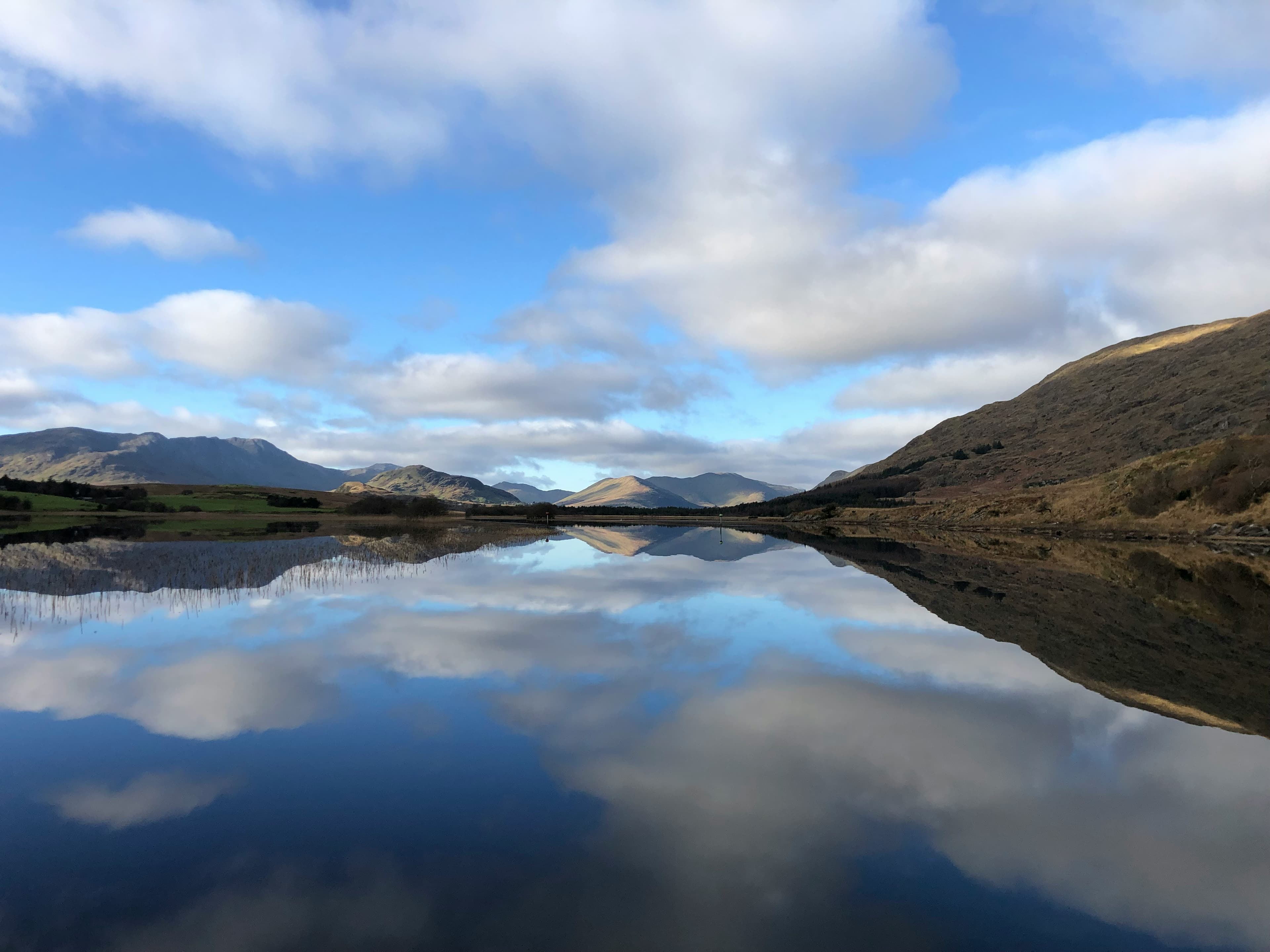
Connemara's Wild Heart
Peat-stained loughs in the shadows of the Twelve Bens, spate rivers that rise and fall with Atlantic rain, and fish that have never seen a stocking lorry.
Connemara delivers Ireland's purest fly fishing in the most Atlantic landscape the country offers. Peat-stained loughs scattered among the Twelve Bens and the Maamturks, their surfaces dark as tea, ruffled by westerlies that never quite stop blowing. Short, steep spate rivers that rise two feet after a night's rain and drop back by lunchtime. And everywhere, wild fish — native brown trout in the loughs, silver sea trout running from the ocean through the estuaries into the river systems between June and August.
The water here is fundamentally different from the limestone loughs of the Irish midlands. Connemara's loughs are acidic and peat-stained — brown-amber water with limited visibility, less diverse insect life than Corrib or Mask, and trout that are correspondingly less selective. The peat tint is the angler's ally: it gives fish confidence, it hides the leader, and it makes the traditional wet-fly approach that Irish lough fishing was built around the most effective method on the water.
This is not manicured fishing. The weather changes hourly. The loughs can be unfishable by noon if the wind rises. The spate rivers produce brilliant fishing for forty-eight hours after rain and then retreat to a trickle. Connemara rewards the angler who is flexible, who watches the weather, and who understands that the fishing here runs on Atlantic time — which is to say, its own.
Brown Trout: The Lough Natives
Half-pound to two-pound fighters with the temperament of fish twice their size. On a mayfly day, the loughs erupt.
Connemara's brown trout are wild, native fish — small by limestone-lough standards but fierce in proportion. Half a pound to two pounds is the typical range, with the peat water producing fish that are darker, harder-fighting, and less discriminating than their counterparts on Corrib or Mask. In the deeper loughs — Inagh, Derryclare — ferox brown trout exceeding ten pounds exist as a genuine if rare big-fish target, trolled deep on sinking lines or taken on large lures.
The wet-fly loch-style tradition is the heart of brown trout fishing here. A team of three or four flies on a floating line, cast ahead of a drifting boat: Invicta on the point, March Brown or Golden Olive Bumble on the droppers, a bushy bob fly dibbled in the surface. The drogue controls the drift. The ghillie reads the water. The retrieve is slow — figure-of-eight with pauses, lifting into takes. This is the same method that works on every Irish lough, adapted to Connemara's shorter drifts and peaty water.
The mayfly — mid-April through June — is the peak event. Hatches on Connemara loughs are less spectacular than Corrib's legendary blizzards, but they produce concentrated surface feeding that makes dry-fly and dapping fishing viable on water that is otherwise predominantly subsurface. Upright olives and sedge patterns cover the dry-fly fishing. Terrestrials — beetles, ants, daddy longlegs — extend the surface season into August and September.
The Prime Loughs
Ballynahinch in its castle shadow, Inagh beneath the Maamturks, Derryclare with its birch-lined shores — each lough has its own character.
Ballynahinch Lake is the centrepiece of Connemara's fishing — managed beats on both lough and river, accessed through the historic Ballynahinch Castle, with a booking system, ghillies, and a tradition that runs back centuries. The lough holds brown trout and sea trout, and the river pools below the castle are among the most productive sea trout water in Ireland. Fishing here feels like participating in a living tradition, not visiting a museum.
Lough Inagh sits beneath the Maamturks in one of the most dramatic settings in Irish fishing. Brown trout in the open water, with good mayfly fishing in late May and June. The wind funnels down the valley and creates the wave that the wet fly needs. Derryclare, birch-lined and intimate, holds smaller but numerous brown trout — excellent for the angler who wants to fish a gentler, more accessible water.
The Toombeola loughs in the Ballynahinch system, the smaller hill loughs scattered through the Bens, and the chain of waters that feed into the Ballynahinch and Gowla systems — all hold wild brown trout and most are fishable with a bit of walking and a map. The ghillie's knowledge of which loughs are fishing well on any given week is worth more than any guidebook.
Sea Trout on the Loughs: Daytime Silver
On Connemara loughs, sea trout are daytime fish — fished from boats with wet flies, exactly like brown trout. Forget the British night-fishing rule.
This is the critical distinction that the Connemara angler must understand: sea trout on Irish loughs feed during the day. The British night-fishing orthodoxy — Falkus on the Cumbrian Esk, the warm July night, the Medicine fly swung in darkness — does not apply to Connemara's lough fishing. Here, sea trout are taken from drifting boats in daylight, on wet-fly teams fished in the same manner as brown trout. The method is loch-style: Sooty Olive, Golden Olive Bumble, Connemara Black on the droppers, with a bushy bob fly on top.
The sea trout run peaks from late June through August. Fish arrive from the Atlantic through the estuaries and move into the lough systems, where they hold in the shallows and feed on shrimp, small fish, and the same invertebrates as the brown trout. Dapping with live mayfly (May–June) or daddy longlegs (August–September) takes sea trout as effectively as it takes browns — the dapped natural dancing on the surface draws fish from depth.
The prime sea trout loughs are the managed fisheries: Ballynahinch, Gowla (the top Connemara sea trout water), Costello and Fermoyle, and Screebe. These fisheries maintain their runs through careful management, and access is through the ghillie system — book in advance, particularly for July and August. A good day on Gowla or Ballynahinch can produce two to five sea trout alongside the brown trout, and a fresh-run sea trout of three or four pounds on a six-weight from a drifting boat is one of the great experiences in Irish fishing.
Sea Trout on the Rivers: The Night Shift
On the rivers — and only on the rivers — sea trout revert to nocturnal behaviour. The Ballynahinch pools after dark are a different world.
The distinction matters: on the loughs, sea trout feed by day. On the rivers, they are nocturnal — particularly in summer when the water is low and clear. The Ballynahinch River pools below the castle, the Gowla River, and the Owenmore hold sea trout that lie invisible during daylight and begin moving at dusk.
The method is traditional night fishing: a floating line, a team of wet flies (Teal Blue and Silver, Connemara Black, Medicine), cast across and downstream and allowed to swing through the pool in the darkness. The take comes as a sharp pull during the swing. Lift into it — do not strike. The rod must be strong enough to control a fresh sea trout that will run hard in the dark, and the angler must know the water well enough to fish it without sight.
Night fishing for sea trout on Connemara's rivers requires familiarity with the pools — walk the beat in daylight, note the wading line and casting obstructions, and mark the lies. When darkness comes, you fish by feel and memory. The first take, in the silence of a Connemara night with only the sound of the river and the distant Atlantic, is worth every hour of the preparation.
Spate Rivers: Brief and Brilliant
Short, steep, and rain-driven — Connemara's rivers produce intense fishing for forty-eight hours after a spate, then retreat to a trickle.
Connemara's spate rivers are short, steep, and entirely dependent on rain. The Ballynahinch River, the Gowla, the Owenmore, and the smaller burns that feed the lough systems rise fast after Atlantic rain — two feet overnight is common — and produce brilliant fishing for brown trout and sea trout as the water colours and the fish move. Forty-eight hours of dropping, clearing water is the prime window. By the third day, the rivers may be too low to fish.
The method on the rivers differs from the loughs. Upstream wet fly or nymph for brown trout in the runs and riffles. Euro nymphing through the deeper pools where trout and sea trout hold. Dry fly when conditions allow — a sedge or olive dun on a rising fish in a clearing pool after a spate is as good as river fishing gets. The nearby Erriff (technically in Mayo but adjacent to Connemara) is one of the finest small spate rivers in Ireland for both salmon and sea trout.
Timing depends on rainfall. Connemara receives over fifteen hundred millimetres of rain annually — more than almost anywhere in Ireland — which means the spate rivers fish more often than not. But the windows are unpredictable, and the angler who combines lough fishing (available most days) with river fishing (when the water comes) gets the best of Connemara.
Tackle: Irish Tradition
A ten-foot six-weight for the loughs, a nine-foot five-weight for the rivers. Floating line only. The ghillie provides the boat.
Lough fishing: a ten-to-eleven-foot rod rated six weight. The length handles the wet-fly team and controls the line on the retrieve in wind. A floating line — Irish lough style does not require sinking lines. A twelve-to-fifteen-foot tapered leader. The flies are traditional Irish patterns: bumbles (Golden Olive, Claret, Bibio), dabblers (Fiery Brown, Green Peter), and bob flies (Bibio, Invicta) that work in the wave.
River fishing: a nine-foot five-weight rod for brown trout and lighter sea trout work. A six-weight for night fishing, where the heavier line helps control the cast in darkness and the extra backbone handles fresh sea trout in confined pools.
Dapping: a thirteen-foot dapping pole with blowline. Live mayfly (May–June) or daddy longlegs (August–September) on size eight to ten hooks. The wind carries the blowline and dances the natural on the surface ahead of the drifting boat. The ghillie provides the boat (curragh or fibreglass pram) and is essential on Connemara loughs — both for safety and for the knowledge of the drifts, the lies, and the conditions that make the difference between a blank and a memorable day.
Weather and Conditions
Atlantic weather — which is to say, all of it at once. A south-westerly breeze is the friend. An east wind is the enemy. Rain is an opportunity.
Connemara's weather is the most Atlantic in Ireland, which means it changes constantly and the angler must adapt. A south-westerly breeze of ten to fifteen knots is the ideal for lough fishing — it creates the wave that brings fish to the wet fly and drives the dapping line ahead of the boat. An east wind is cold, flat, and fishless on the loughs. Rain is not a problem — it is an opportunity, because it raises the rivers and moves sea trout.
The loughs can become unfishable if the wind exceeds twenty knots — too rough for safe boat work, too wild for effective casting. Plan for weather flexibility: a lough day when conditions are moderate, a river day when rain has brought the water up, and a hill loch or sheltered bay when the wind is too strong for the open water. The ghillie's morning assessment of conditions — which lough to fish, which drift to take, whether to wait for the afternoon — is the most valuable piece of information the angler receives each day.
The Connemara Year
Mayfly browns in May, sea trout from late June, dapping daddies in August, autumn olives into October.
April and May: the brown trout season builds. Early season wet-fly fishing on the loughs with dabblers and bumbles over the rocky shallows. Mayfly hatches begin mid-April on some waters, peaking in late May and June — dapping and dry fly when the duns are on the water, wet fly between hatches.
Late June through August: the sea trout arrive. The managed fisheries (Ballynahinch, Gowla, Costello, Screebe) come alive as silver fish enter the loughs and rivers. Daytime lough fishing with wet flies and dapping for both species. Evening and night fishing on the rivers for sea trout.
August and September: dapping with daddy longlegs on the loughs. Terrestrials on the rivers — beetles, ants — produce surface feeding from brown trout in the pools and runs. The sea trout run tails off through September.
October: autumn olives bring brown trout back to the surface. The loughs produce the last good fishing before winter. Late season can be excellent on settled, mild days with a gentle south-westerly breeze.
Access and Licences
Brown trout are often permit-free. Sea trout require a state salmon/sea trout stamp. The managed fisheries book through their offices.
Brown trout fishing on most Connemara loughs is permit-free — a remarkable fact in a world of increasing access restriction. You need a rod and a boat, and on many waters that is all. The hill loughs are entirely open.
Sea trout (and salmon) require a state salmon and sea trout licence stamp, purchased from Inland Fisheries Ireland. The managed fisheries — Ballynahinch, Gowla, Costello, Screebe — have their own permit and booking systems. Book in advance for peak sea trout season (July–August), particularly for Gowla and Ballynahinch. Ghillie costs run from a hundred and fifty to two hundred and fifty euros per day, which covers the boat, the local knowledge, and the access to beats that are not available otherwise.
Catch and release is encouraged on all waters and mandatory for salmon on most. Barbless hooks, rubber nets, and wet hands. Sea trout populations in Connemara have been under pressure from sea lice originating from aquaculture, and the conservation of wild sea trout depends on responsible angling practice as much as it does on industry regulation.
Your Connemara Day
Ghillie assessment at dawn, lough drifts through the morning, river pools if the water is up, dapping if the mayfly or daddies are on.
Dawn: the ghillie assesses conditions — wind direction and strength, which lough to fish, which drifts to take. Trust the assessment. Rig the lough rod with a wet-fly team: bumble on the point, dabbler on the dropper, bushy bob fly on top.
Morning: three to five drifts along the windward shallows. Vary the retrieve speed and the bob-fly action until the fish show themselves. On a good day with a steady south-westerly, the fishing can be constant — five to twelve brown trout on a morning's drifting, with the possibility of a sea trout among them from late June onwards.
Midday: if the mayfly is hatching, switch to dapping or dry fly. If the wind has dropped and the lough is flat, consider a move to the river pools (if rain has brought water) or a sheltered bay where the boat can still drift.
Afternoon and evening: on the loughs, the last drift of the day as the wind softens can produce the best fish. On the rivers, the evening brings sea trout to the pools — the transition from daytime quiet to dusk activity is the moment to be on the water. After dark, the night fishing begins for those with the permit, the knowledge, and the nerve.