Incapable of Surveillance
Late one sunny evening in a gorge, I looked up and felt a little uneasy. The sky was full of hovering dragonflies.
Late one sunny evening in a remote and pretty gorge, I looked up and felt a little uneasy as the sky above me was filled with hundreds of hovering dragonflies. It seemed like something out of a dystopian sci-fi future except that these elegant creatures were, I reassured myself, incapable of surveillance.
As impressive a sight as these winged predators were, early dragonflies were the size of a gull, the largest of them boasting an awesome wingspan of over 70cm. Their modern counterparts claim a top speed of over 30mph, can change direction in an instant and can send their two sets of wings in and out of phase depending on whether they want to hover or race forwards. They regularly cross oceans and flourish on every continent except Antarctica.
Life Beneath the Surface
Odonata nymphs inhabit lakes and running water — voracious predators and highly prized prey.
The nymphs of Odonata, the scientific order containing dragonflies and damselflies, inhabit lakes and running water. Their size makes them both voracious predators of the smallest fish fry and a highly prised prey for many adult freshwater fish including trout. Put simply, an angler should know about these creatures and, to know is to be amazed.
It is natural for us to pity the few months, weeks or even days that these creatures may live on the wing. In fact, they spend their lives underwater with a brief and often violent bout of sex at the end of their days. Most live between one and three years, which is about as long as a rat can hope for and comfortably longer than several recent British prime ministers have managed to hold onto their office.
The Mask
A rapacious predator with a hinged lower lip that shoots out to snatch prey — possibly inspiring the creature in Alien.
The dragonfly nymph in particular is a rapacious predator quite capable of eating a small fish. The way it captures prey is in itself both remarkable and somewhat terrifying. A huge hinged lower lip (the labium) tipped off with movable teeth, called a mask, shoots out to capture its prey before dragging it back to the creature's mouth. The whole grisly process possibly inspiring the mouthparts of the alien in Alien. Adults bite their prey's wings off and swallow their meals headfirst.
The Wheel
Feigning death to avoid it, barbed penises to scoop out rivals, and a sex position that forms a heart shape.
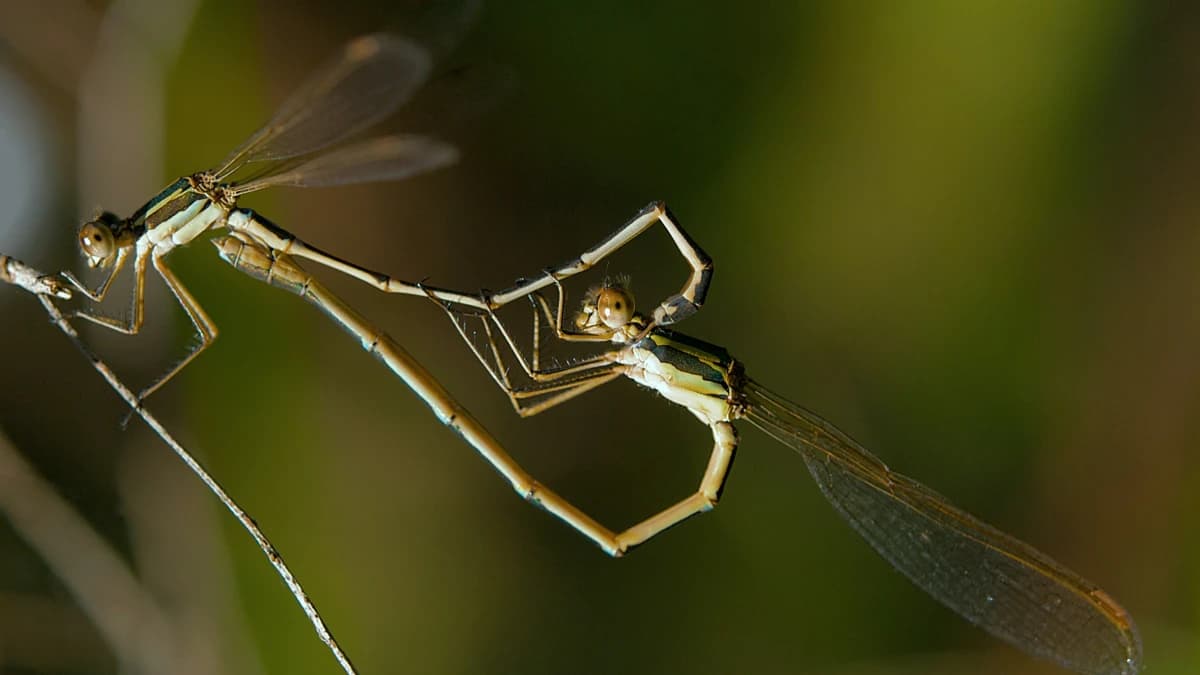
The male dragonfly or damselfly, having defended his turf from competing males, latches onto a female by gripping her prothorax from behind with his specially adapted claspers. The females of one species of dragonfly sometimes feign death to avoid sex. While others fight off unwanted advances — sometimes with lethal effect. Assuming the female is willing, she will bend her tail section around so that her genitals and his align. The mismatched locations of each set of genitals result in the romantic heart-shaped or 'wheel' sex position.
Some males have special barbs on their penises to scoop out competitors' sperm and even those without barbs will use their penis to move competing sperm out of the way. The male then has to transfer his sperm from his gonad parts down to his penis (inconveniently separated by several abdominal segments). He does this by folding himself in two and only then is he ready for business.
As complicated as that sounds, for the male, his work is not nearly done. Generally, only the last male to have sex with the female gets to fertilise the eggs and transfer his genes. Any earlier suitors are likely to have wasted their time. Male damselflies and dragonflies will often endure a dunking as they hang under the female to make sure no other male slips in before she lays her eggs. Meanwhile the females do their best to avoid getting killed by frenzied Johnny-come-lately male suitors.
Arsetronautics
The most remarkable arsehole in the animal kingdom — rectal jet propulsion in dragonfly nymphs.
Dragonflies and damselflies are pretty tolerant of water that would have other aquatic insects gasping. And breathing brings us on to what can only be described as the most remarkable arsehole in the animal kingdom. The dragonfly not only breathes through its anus, it uses it as a jet propulsion system so that it can 'fly' through the water in dramatic swoops, 'arsetronautics' if you will. In practice, this jet is an escape mechanism rather than a mode of travel — dragonfly nymphs are ambush predators that spend most of their time crawling slowly on the bottom.
Damselflies somewhat disappointingly breathe through three feathery gills at the tip of their tail. It is actually the damselfly nymph, which genuinely swims with an undulating wiggle through open water, whose movement canny fly fishermen imitate with short tugs on the line.
What the Angler Sees
Goddard noted that adult dragonflies are of little interest to the angler. The nymphs, however, are a different matter.
In John Goddard's delightful and essential Waterside Guide, he notes that adult dragonflies are of little interest to the angler as they are seldom near enough to the water. It is also hard to know to what extent the big juicy nymphs are taken as they often exit the water at night and spend their days in thick weed. What is certain though is that the slimmer-bodied damselfly nymph, lacking an anal jet propulsion system, is a common meal and is frequently imitated by fly anglers.
Turning Knowledge into Fish
On reservoirs from May to September, damselfly nymphs are one of the most reliable patterns in the box.
On reservoirs and stocked stillwaters from May to September, damselfly nymphs are one of the most reliable patterns in the box. Fish an olive or brown damsel nymph on a floating line along the margins and weed beds, using a slow figure-of-eight retrieve punctuated by short strips — that undulating swim is what you're imitating. The best days come in warm, still weather when the nymphs migrate shoreward in numbers to emerge, and trout follow them in.
Watch for swirls and bow-waves in two feet of water near the reed line: that's a fish hunting damsels, and you should be there too. On rivers, dragonfly nymphs matter less to the angler — they're bottom-dwelling ambush predators that rarely swim in open water — but a big, dark nymph fished dead-drift along a weedy undercut bank can interest a trout that has grown tired of olives.
Devils, Spies, and Surgeons
In Japan they bring in autumn and valour. In Europe they sew the mouths of gossips shut.
Dragonflies are remarkable, adaptable and impressive creatures. With their penchant for eating mosquitoes, they have no doubt saved many human lives and cost none. They have gone their own way in the fields of underwater motion, eating and sex: without even going into their astonishing flying and hovering abilities.
In Japan, they bring in the autumn and are associated with valour and joy while in Europe they are often connected to the Devil and his intimates. They are said to use their bodies to sew the mouths of gossips shut and to perform life-saving field surgery on serpents. They are even accused of acting as aerial spies for malevolent powers.
Perhaps the next time you are out on the water, dazzled by the beauty, grace and downright improbability of dragonflies and damselflies, will be the last time you can innocently enjoy their antics without wondering if they are indeed watching you.