Know What You're Standing In Front Of
Little blue puddles on the map — and the most honest trout classrooms we have.
Small stillwaters in the British Isles look tame on the map — little blue puddles in sheep fields and quarry pits — but they might be the most ruthlessly honest trout classrooms we have. You cannot hide behind a long cast or a complicated drift on a five-acre lake. The fish can see you. The water has edges. Everything you do, right or wrong, happens at close quarters, and the trout notice.
Most of these waters are man-made: farm ponds, estate lakes, old brick pits, or miniature reservoirs you can walk around before your coffee goes cold. They are typically stocked with rainbow trout, often with some browns or tiger trout for variety, and managed so anglers can take fish without leaning on wild populations. That "managed" bit is important. The fish didn't choose to be there, but they adapt fast, and within a few days of stocking they are behaving like fish that have always lived there — which is to say, they are being awkward.
Two facts shape how you fish them. First, they are closed systems with limited volume and structure, so fish quickly learn where the food and the oxygen are, and they return to those places with the reliability of a commuter. Second, stocked rainbows cruise constantly, but pressure and bright conditions push them into predictable depth bands and travel routes. Your job, reduced to its essentials, is to find the depth band and intercept the patrol.
Think of the lake as three overlapping layers rather than "a pond": the top metre, the mid-water band, and the bottom third. Each has its own food, its own moods, and its own fishing through the year. Get the layer right and you are in the game. Get it wrong and you are casting into furniture.
Reading the Water: Where Trout Actually Are
They are rarely random. Position is almost always about food, comfort, and energy — in that order.
On small stillwaters, trout are rarely "random." Their position is almost always about food, comfort, and energy savings — in that order. A trout that looks like it is aimlessly cruising is in fact patrolling a beat, and the beat exists because something useful is at one end of it. Your first job is not to cast. It is to watch.
The windward shore and corners are where the wind pushes surface food — buzzers, terrestrials, spent spinners — and warmer surface water. Trout follow. On a mild day with a steady breeze, the downwind bank is often the place to be, even though the casting is harder. The fish don't care about your casting comfort.
Shallow bays with old weed beds are factories — bloodworm, shrimp, snails, the whole cold-buffet of invertebrate life. In winter, when the deep water is semi-dormant, these silty bays can be the most productive spots on the lake. Drop-offs and ledges make ideal patrol routes: one fin-flick takes a trout from safety to the buffet and back. Inflows and outflows bring extra oxygen and drifting invertebrates, and they matter most in summer when the rest of the lake is warm and sluggish.
A practical approach that guides and competition anglers repeat until it sounds obvious: spend the first ten to fifteen minutes walking. Look for rises, bow-waves, or nervous water rather than rushing to the nearest platform. Start where the wind helps your casting but brings food into your bank, ideally casting across the breeze and letting the line swing in a gentle arc. If you are blanking in the middle of the lake in flat, cold weather, the science says you are probably over deep, low-productivity water while the trout are nosing around the silty, food-rich margins behind you.
Spring: Cool Water, Rising Prospects
The water is cool, the insects are thinking about it, and the trout are deciding whether to commit.
Spring on a small stillwater has a particular optimism about it. The water is cool, the first insects are beginning to stir in the surface layers, and the trout — especially recently stocked fish that haven't yet learned caution — cruise the top two to four feet with a confidence they will lose by June. Cloud cover and a light wind are your allies. Flat calm and bright sun are not.
A floating line with a long leader, or a slow intermediate, is usually all you need. Fish small lures or damsel nymphs, varying the retrieve from a slow figure-of-eight to short pulls until something connects. Buzzers fished static or very slowly are the other reliable approach; a two-fly setup with different depths lets you bracket the feeding zone without guessing. The point fly at eight feet, the dropper at three and a half — you are covering the water column efficiently, and one of them will be right.
Summer: The Depth Game
Warm surface layers push trout deeper by day, but dawn and dusk belong to the angler who waits.
Summer complicates things in the way that warm weather always does: the surface is pleasant for the angler but often too warm for the trout, especially in the middle of the day. Fish push deeper during bright, calm periods, seeking the cooler water and the dissolved oxygen that comes with it. But they haven't stopped feeding — they've just moved the restaurant downstairs.
Early and late in the day, trout often move back into the top metre to intercept damsels, terrestrials, and emerging buzzers. This is the fishing worth getting up early for. Mid-day, switch to an intermediate or sink-tip line with nymphs or mini-lures fished slower than you think. The fish are conserving energy in the heat, and a fly ripping past at competition speed does not interest them. Slow, deliberate, just enough movement to suggest life. Patience is doing more work than your rod arm.
Autumn and Winter: Back to the Margins
Cooling water and dying weed send the food — and the trout — back to surprisingly shallow water.
As the water cools and the weed dies back, something counterintuitive happens: the invertebrates that were hiding in the vegetation get pushed out into open water, and the shallow bays fill up with concentrated food — bloodworms, corixa, shrimps. The trout follow. On milder days, fish move back into surprisingly shallow water for the calories and the better light. The angler who insists on fishing the deepest hole is often fishing the emptiest water.
Work the back of bays and the first break off the bank. Buzzers, bloodworm patterns, and small nymphs under an indicator or on a slow retrieve are the rational choices. In very cold snaps, a slow, deep presentation with a single weighted nymph or lure fished on a count-down often wins. The fish are there. They are just doing everything more slowly, and you must do the same.
Flies and Rigs
The key is not the pattern name but the depth and speed you present it at.
Stomach sampling and fishery surveys are consistent: stocked rainbows and browns in small UK lakes eat chironomid larvae, pupae, freshwater shrimp, snails, corixa, sticklebacks, and other fry. Your fly box should be organised around those facts, not around what the fly shop is promoting this month.
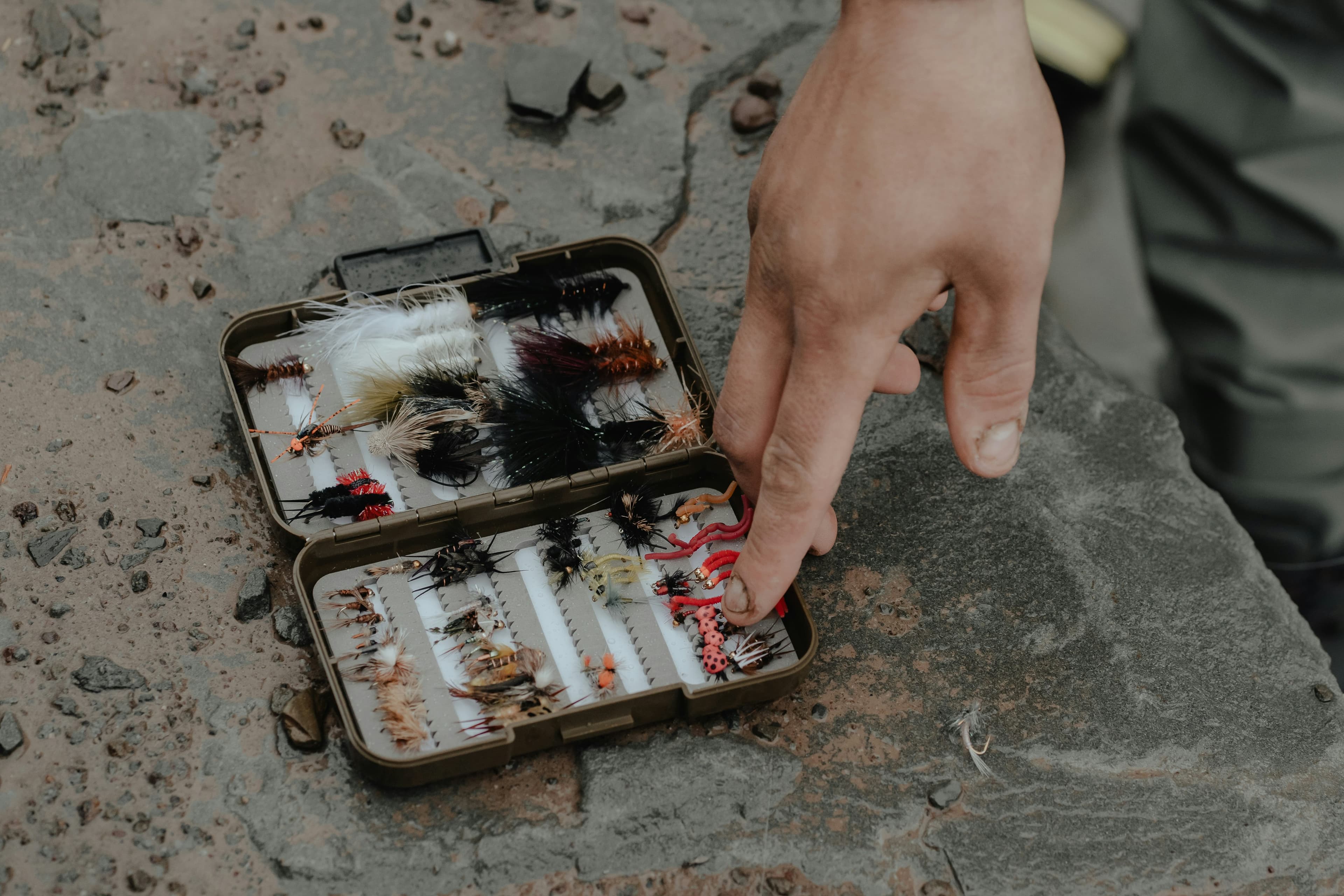
Three categories cover the work. First, lures and attractors: damsels, Cats Whiskers, Fritz blobs and boobies, small fish imitations. These are essential for searching water, for newly stocked fish that respond to movement, and for dirty conditions where subtlety is wasted. Second, natural nymphs and buzzers: slim black and olive buzzers, crunchers, diawl bachs, red bloodworm imitations. These are bread-and-butter food for trout almost year-round, and the angler who can fish a buzzer well will rarely blank. Third, dries and emergers: CDC emergers, Shipman's buzzers, hoppers, small sedge patterns. Deadly when fish are sipping in the film on mild days.
Rigs should be simple. A single fly on a floating line with a twelve-to-sixteen-foot leader is often the most effective approach on pressured water — it avoids spooking fish and produces cleaner casts. A two-fly rig under an indicator, with the dropper at three and a half feet and the point at eight feet in ten-to-twelve-foot water, covers both mid-water and near-bottom feeders without complicated casting. Fine fluorocarbon leaders in clear water improve presentation substantially. Use them.
The pattern name matters less than you think. Change the depth systematically before changing the fly at random. A Diawl Bach at six feet catching nothing will not catch more at six feet if you swap it for a Hare's Ear. But the same Diawl Bach dropped to ten feet might solve the problem entirely.
Retrieves and Pressure
Start slow. Speed up only at the end of the cast, when a chase-take is your last chance.
Stocked trout learn. A fish that took a Cats Whisker on a fast strip in its first week will, after a fortnight of angling pressure, ignore the same fly fished the same way. Heavy pressure makes trout shy of fast-pulled, bright lures and increasingly responsive to small, static, or very slow presentations. Repeated casting, wading, and noisy line-stripping pushes fish off the bank into deeper or less accessible water. Understand this and you understand why the quiet angler at the end of the lake often outfishes the energetic one in the middle.
Begin retrieves slowly, increasing speed only at the end of the cast to trigger a chase-take from any fish that has followed without committing. When fish are visibly spooky — waking away from your fly line, refusing at the last moment — reduce fly size, leader diameter, and the number of casts. Think ambush, not artillery. With buzzer or nymph setups, embrace the static or inch-by-inch figure-of-eight. Many of the largest fish taken from small stillwaters are caught by anglers doing almost nothing — the line simply tightens, and a fish is there.
On cold days, trout often respond to slow but continuous retrieves where the take registers as the line gradually tightening rather than a sharp pull. Do not strike at these. Lift the rod steadily until you feel the weight of the fish, then let the hook do its work.
Tackle: Simple but Intentional
You do not need a competition locker room. You need a floating line, an intermediate, and the discipline to use both.
A nine-to-ten-foot rod rated six or seven weight provides the length for distance and wind control, with backbone enough for hard-fighting stockie rainbows. A weight-forward floating line is the workhorse — it covers eighty per cent of the fishing. A slow intermediate handles the two-to-six-foot zone. An optional fast sink or sink-tip earns its place for deep banks and winter work, but it is not essential.
Leaders and tippet: eight-to-twelve-pound fluorocarbon for lure fishing, where takes are hard and fish run through weed. Five-to-eight-pound for nymphs and dries on pressured fish, where finesse outweighs strength. Many experienced stillwater anglers keep two rods rigged — one with a lure or streamer setup, one with nymphs or buzzers — so they can switch methods in seconds when fish change depth or begin rising. This is not extravagance. It is efficiency.
Fish Welfare and Your Part in It
The fish did not choose to be there. Handle them as though they did.
Most small stillwaters in the UK are stocked with hatchery trout to provide sport while taking pressure off wild river populations. Managers are increasingly expected to follow good-practice guidance on stocking density, genetics, and disease control, and the better fisheries take this seriously. As an angler, your part in the bargain is smaller but it matters.
Use barbless or de-barbed hooks where possible, especially on catch-and-release tickets. They reduce handling time and damage significantly, and the fish you release has a measurably better chance of recovery. Keep fish in the water while unhooking. If you must photograph one, support it gently just above the surface — studies show air exposure lengthens recovery time and increases mortality, which is a polite way of saying the fish suffers for your Instagram.
Respect bag limits and size rules. These are set using carrying-capacity calculations and growth data specific to each water, not plucked from the air. And support fisheries that maintain good water quality and habitat — weed beds, margins, overhanging cover — instead of turning lakes into featureless bowls. Those features are what make the fishing interesting, and they are what make the fishery sustainable. A sterile pond with a thousand stockies in it is a business model, not a fishery.
A Practical Day Plan
Walk first. Watch. Then fish with the discipline of someone who has been watching.
Arrival: walk the bank. Watch for rises, bow-waves, and wind lanes. Choose a position where the wind brings food towards your bank, not away from it. Resist the urge to set up at the first empty platform.
First hour: floating line, single lure or damsel. Count down five to ten seconds and vary the retrieve from slow figure-of-eight to long pulls. Note any follows — they tell you the depth, even if the fish does not commit.
If fish are mid-water or deep: swap to a slow intermediate or a simple indicator rig with two buzzers at different depths. Let them fish almost static. This is not inactivity. It is precision.
If you see subtle rises: change to small emergers or CDC dries on fine tippet. Reduce casting frequency. Keep low. The fish that are rising in the film are the most wary fish in the lake, and they have earned the right to be suspicious.
Late session: re-check the windward corner or the inflow, especially as light levels drop. Fish often move back into the top layers towards evening, and the last hour of a day on a small stillwater can redeem the previous five.
Do this with some discipline, and you are no longer hoping for a stockie to blunder into your fly. You are hunting a trout that lives by the same physics and biology on every small stillwater in the country. The water changes. The principles do not.