The Alpine Stream: Cold, Fast, and Honest
These are not chalkstream mayfly parades. They are mayflies, stoneflies, and caddis snowmelt-driven, and the trout eat eighty per cent of their food off the bottom.
Mountain streams across Europe — from the Pyrenees to the Alps to the Balkans — run cold, fast, and over rock. They are fed by snowmelt and rain, governed by altitude and geology, and populated by trout that have adapted to a world where the food is sparse, the current is relentless, and the growing season is short. These are not the fertile rivers of the English lowlands. The insect life is compact but reliable, and the trout — browns, brookies on some waters, the magnificent marble trout of the Julian Alps — devour it with the efficiency of animals that cannot afford to waste a calorie.
The insect community is EPT-heavy: Ephemeroptera, Plecoptera, Trichoptera — mayflies, stoneflies, and caddis. These three orders account for seventy per cent or more of the trout's diet in clean mountain water. The remainder is chironomids, terrestrials, and — on the larger rivers — sculpin and small fish. The hatches are tied to snowmelt, altitude, and water temperature rather than the calendar dates that work on lowland rivers. A Pyrenean valley at six hundred metres may fish like spring in April; the same latitude at eighteen hundred metres may not wake up until July.
Understanding these insects — what they are, when they emerge, and how the trout eat them — is the key to unlocking mountain stream fishing from the Soča to the Sella, from the Inn to the Gave d'Ossau. Euro nymphing dominates because the fish feed subsurface. But knowing why they feed subsurface, and on what, makes the nymphing precise rather than hopeful.
Stoneflies (Plecoptera) — The Armoured Tanks
The apex invertebrate predators of fast European rivers. Their presence indicates excellent water quality.
Stoneflies are the signature order of mountain streams. Large predatory nymphs of the Perlidae family — Perla and Dinocras species — are the apex invertebrate predators, with a two-to-three-year development cycle spent crawling the undersides of boulders in fast, well-oxygenated water. Their presence is an indicator of water quality: they cannot survive in degraded or low-oxygen conditions.
Smaller families matter equally to the angler. Nemouridae — tiny black stoneflies — are early-season pioneers, active from March on lower-altitude streams. Perlodidae — including Yellow Sally (Isoperla grammatica) — fill the summer window from May through July, the only plecopteran active in high summer. The thermal envelope runs from trigger ten degrees to peak fourteen.
Stoneflies emerge by crawling out of the water onto bankside rocks — not through the surface film like mayflies. The shed exuviae on rocks are a reliable indicator of stonefly activity. This terrestrial emergence means the nymph stage is far more important to anglers than the adult. Heavy nymph patterns — Czech nymphs, Perdigon stonefly imitations, rubber-legged patterns on size twelve to sixteen — fished tight to the bottom through runs and pocket water. Swing through riffles post-spate, when dislodged nymphs are tumbling through the current and the trout know it.
Needle Flies (Leuctridae) — Autumn Through Winter
September through February. Often the last and first hatches of the season — the grayling angler's friend.
Leuctra species — the needle flies — are small, slim stoneflies characteristic of clean fast water. Their thermal envelope is low: trigger four degrees, peak eight, maximum thirteen. The seasonal window runs from September through November for Leuctra, extending into December through February for the winter Nemouridae species on mild-winter streams. These are the insects that keep grayling feeding when everything else has shut down.
The nymphs hug the bottom year-round, emerging by crawling out onto bankside rocks. Trout and grayling feed on them subsurface, nosing into the gravel in low, clear water. A dark quill-wing dry on a size eighteen to twenty-two matches the adult for the rare surface opportunities. Dead-drift at the heads of runs, where the current concentrates drifting nymphs. On Alpine rivers, needle flies are often the final hatch of the season and one of the most important food sources for autumn grayling.
Mayflies (Ephemeroptera) — The Alpine Sippers
Rhithrogena in spring and summer, Baetis year-round — the upwinged flies that bring trout to the surface on mountain rivers.
Mayflies on mountain streams have a different character from the prolific hatches of lowland rivers. They are sparser, more weather-dependent, and the trout rise to them with a selectivity born of scarcity — when insects are few, each one matters. The reward for understanding the alpine mayfly community is the sight of wild trout rising in water so clear you can count the pebbles on the riverbed twenty feet below.
Rhithrogena is the dominant genus — multiple species (R. semicolorata, R. alpestris, R. picteti) producing reliable hatches from April through July on limestone-influenced rivers. These are stone-clinger nymphs, flattened and adapted to fast current, with a thermal envelope of trigger seven degrees to peak twelve. The hatches peak in May on lower Alpine rivers and extend into July at higher elevations. This is the defining upwinged group of continental European fly fishing, richer and more diverse than UK Rhithrogena.
Baetis rhodani — the Large Dark Olive — is present in its alpine form from the earliest spring through to the autumn brood in October. It is the universal European upwinged: hardy, widespread, and dependable when other species are absent. Flat-bodied nymph patterns — gold-ribbed hare's ear, Perdigon, Rhithrogena-style flat nymphs — match the stone-clingers. Parachute olives and CDC emergers cover the surface feeding when fish rise.
Caddisflies (Trichoptera) — The Case-Building Architects
Free-living predators, net-spinners, and case-builders — the caddis diversity on Alpine rivers exceeds anything in the British Isles.
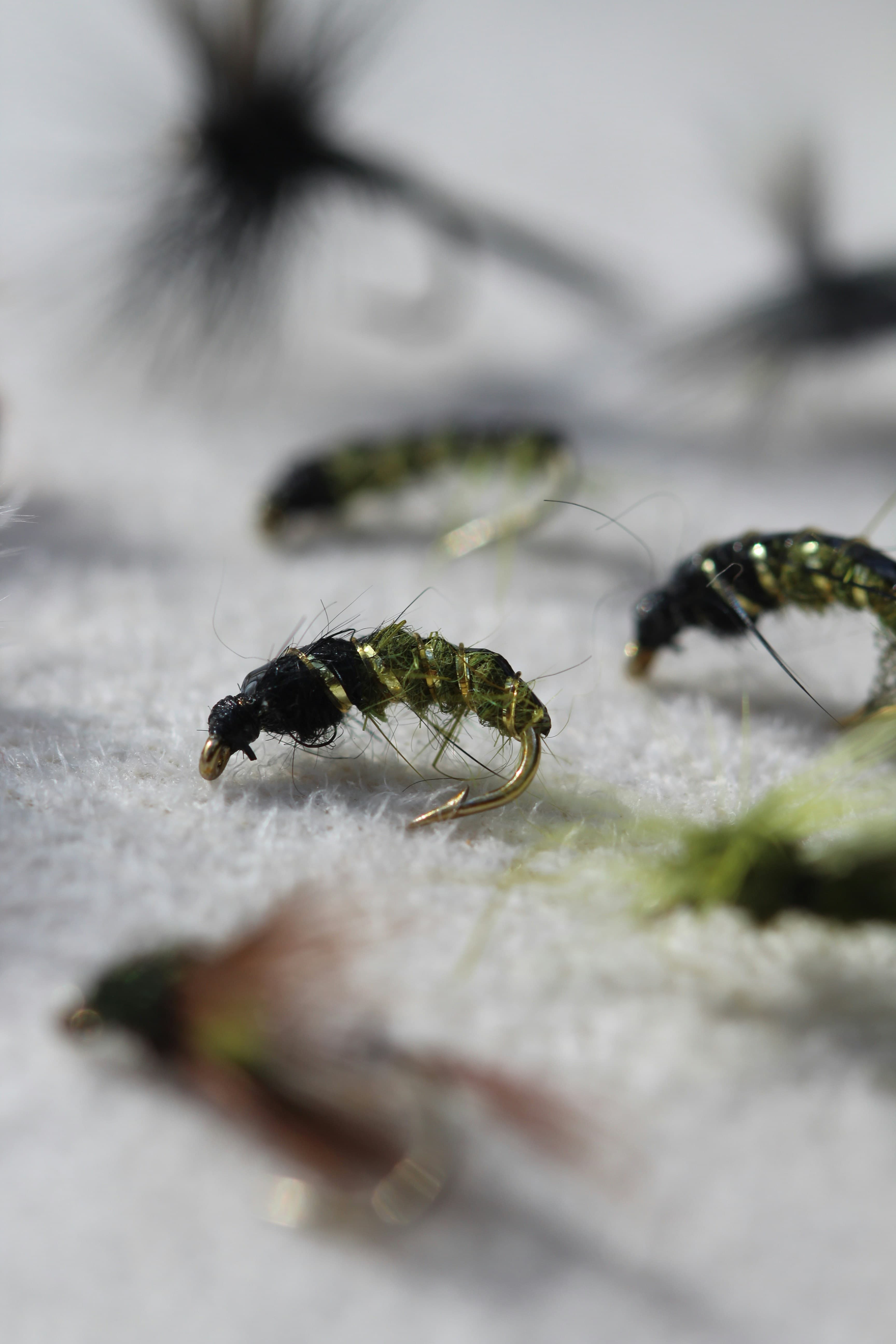
Caddis are the second pillar of the alpine EPT community, and on many mountain rivers they are the most abundant order. Three ecological guilds dominate. Free-living Rhyacophila — the green rock worms — are predatory larvae without cases, clinging to rocks in fast water and vulnerable to dislodgement in spate. Net-spinning Hydropsyche build silk capture nets in moderate-to-fast current, filtering food from the drift. Case-building Potamophylax and Sericostoma construct portable shelters from vegetation and small stones in slower reaches.
The nymph stage is the primary food source — caddis larvae are available year-round, and heavy nymph patterns bounced through pocket water catch trout consistently. The pupal stage, when the insect ascends rapidly through the water column to emerge at the surface, triggers aggressive feeding — the ascending pupa is vulnerable, visible, and irresistible. Evening sedge hatches from June through August produce the most exciting surface fishing on Alpine rivers.
A green rock worm pattern on a size fourteen to sixteen — Czech nymph profile, olive or green body, tungsten bead — is the searching pattern for mountain caddis. Caddis pupa patterns fished on the swing through the evening hatch complete the approach.
Midges and Terrestrials — The Background and the Windfall
Chironomids are universal. Terrestrials from alpine meadows fill the summer gap between morning and evening aquatic hatches.
Chironomids are present in every water body in Europe, and mountain streams are no exception. They are the universal background food — bloodworm larvae in silty pools, pupae ascending through the water column, tiny adults collecting in the surface film. They peak in spring and autumn on mountain streams, and on days when nothing else is hatching, a zebra midge or a red larva on a size eighteen to twenty-two dead-drifted through a pool will produce when larger patterns fail.
Terrestrials are the summer windfall that makes alpine fishing unique. Beetles, ants, and heather flies tumble from alpine meadows onto the water surface from July through September, and trout that have been nymphing all morning will come to the surface for a beetle without hesitation. On many Alpine rivers, a foam beetle or a foam ant pattern is the default summer dry fly — the pattern that fills the gap between the morning stonefly hatch and the evening sedge. Short casts to the banks, under overhanging vegetation, tight to the rocks. The take is often immediate and confident.
Sculpin, Minnows, and Gammarus — The Protein Layer
On limestone-influenced rivers, freshwater shrimp are year-round food. On the Soča system, sculpin feed the marble trout.
Not all alpine streams are acidic and food-poor. Limestone-influenced rivers — the Soča and its tributaries, many Austrian rivers, the Pyrenean limestone gorges — support healthy populations of freshwater shrimp (Gammarus) that provide year-round protein for trout. A shrimp pattern fished deep through runs and pool tails is effective on any alkaline mountain river, twelve months of the year.
On the Soča-system rivers of Slovenia and Italy, sculpin (Cottus gobio) and minnows are a critical food source for larger trout and especially marble trout (Salmo marmoratus). Marble trout above three to four pounds feed heavily on small fish, and a streamer or sculpin pattern fished deep through the pools and runs of the Soča, Idrijca, or Tolminka is the method for targeting the largest fish these rivers hold. This piscivorous feeding is a distinct food group that any guide to Alpine entomology must acknowledge — the biggest trout in the system are not eating size eighteen nymphs.
Altitude and Timing: Reading the Vertical Calendar
Four hundred metres to eighteen hundred metres — the same river fishes like three different rivers depending on where you stand.
Altitude compresses the season and shifts the hatch calendar in ways that calendar dates cannot capture. The same river system can fish like spring in April at four hundred metres and remain locked in winter at eighteen hundred metres. Understanding the altitude bands is essential for planning when and where to fish.
Valley floors and lower gorges — four hundred to one thousand metres. This is where the best trout fishing in the Alps, Pyrenees, and Balkans happens: the lower Soča, the Inn valley, the Pyrenean limestone rivers. The season starts in March or April with Large Dark Olives and stonefly nymphs. Rhithrogena peaks in May. Caddis and terrestrials carry the summer. The full EPT community is present, and dry-fly fishing is viable from April through October.
Mid-altitude streams — one thousand to eighteen hundred metres. The season compresses to May through September. Rhithrogena and caddis dominate June through August. Stonefly nymphs are the year-round food. Euro nymphing is the primary method because the water is fast, cold, and the surface hatches are brief. The fishing is excellent but the windows are shorter.
Above eighteen hundred metres, productive trout water becomes scarce. The treeline in the Alps sits at eighteen hundred to twenty-two hundred metres, and above it the streams are typically too cold, too steep, and too food-poor for significant trout populations. High-altitude lakes may hold char or stunted browns, but this is not the fishing that most anglers travel for. The productive alpine stream fishing — the Soča, the rivers of the Pyrenees, the Austrian and Bavarian limestone rivers — happens between four hundred and fifteen hundred metres.
Stream Position and Method
Riffles for stonefly nymphs, runs for mayflies, pool heads for emerging pupae, margins for terrestrials.
Riffles and pocket water: stonefly nymph territory. Czech nymph setup, heavy tungsten point fly, bounced through the boulders and seams. The broken surface hides the angler, and the stonefly nymphs — dislodged by current or migrating between rocks — are concentrated in the fastest water. Post-spate, this is where the fishing is richest: displaced nymphs tumbling through the system and trout positioned to intercept them.
Runs and current seams: mayfly nymph and midge territory. French leader at range, or tight-line Euro nymphing through the deeper sections. The flat-bodied Rhithrogena and Baetis nymphs hold in the current seams where the flow delivers food efficiently. Static drift through the feeding lane.
Pool heads: emerging caddis pupae ascending through the water column. Dead-drift a pupa pattern through the head of the pool where the current concentrates ascending insects. Evening sedge hatches concentrate here.
Margins and bankside: terrestrials after wind. Short casts tight to the rocks and overhanging vegetation. The trout that refuse everything in mid-stream will often take a beetle landed six inches from the bank without hesitation.
The Alpine Nymph Team
Perdigon stonefly on the point, green rock worm caddis above, Baetis nymph and zebra midge on the droppers.
The four-fly Euro nymph team for mountain streams, on an eighteen-foot leader with sighter, fished on a ten-and-a-half-foot three-weight rod. Point fly: Perdigon stonefly nymph, size fourteen, tungsten bead — the anchor fly that reaches the bottom and holds depth through fast water. First dropper: green rock worm caddis, size sixteen — the most common caddis profile in mountain streams. Second dropper: Baetis nymph, size eighteen — flat-bodied, matching the stone-clinger mayflies. Bob: zebra midge, size twenty — the universal background pattern that picks up fish feeding on chironomids between the EPT hatches.
Adjust by altitude and season. At lower elevations in spring, drop the midge and add a heavier second stonefly nymph — the water is faster and deeper, and depth is everything. At higher elevations in summer, lighten the team and extend the tippet — the water is thinner and the fish more wary. Carry terrestrial dries — foam beetle, foam ant — for the afternoon gap when the aquatic hatches pause and the meadow insects start falling.
Climate Shift: The Vertical Migration
Mayflies retreating uphill. Stoneflies expanding. The insect map of European mountains is being redrawn.
The insect communities of European mountain streams are changing. Research on Swiss running waters has documented a pattern that anglers on Alpine rivers are beginning to notice: mayfly assemblages are shifting uphill as water temperatures rise, retreating to higher altitudes where the thermal conditions they require still exist. Stoneflies, which tolerate a broader temperature range and are less dependent on specific thermal cues for emergence, are expanding their distribution.
What this means for the angler is that the hatch calendar is not fixed. Rivers that produced reliable Rhithrogena hatches in May a decade ago may now see them in April. Streams at twelve hundred metres that were marginal for mayflies are becoming more productive as temperatures rise. The EPT balance is shifting, and the angler who pays attention to what is actually in the water — rather than what the guidebook says should be there — will fish more effectively as the mountains warm.
It is, to put it plainly, not good news. The cold, clean, fast-water habitats that support the richest invertebrate communities are the most vulnerable to climate change. The fishing may shift uphill. But the mountains do not go up forever.