The Subsurface Reality
Trout eat nymphs eighty to ninety per cent of the time. Euro nymphing stopped pretending otherwise.
There is a beautiful dishonesty at the heart of traditional fly fishing: we prefer to watch a trout rise to a floating fly, so we have built an entire culture around the ten to twenty per cent of feeding that happens on the surface. The dry fly is elegant, visible, and emotionally satisfying. It is also, for most of the day on most rivers, the wrong approach.
Euro nymphing — Czech nymphing, French leader, and the modern hybrid techniques that evolved from Eastern European competition circuits — represents fly fishing's overdue reckoning with subsurface reality. These methods put weighted nymphs directly into the trout's feeding zone, tight to the bottom, with a sensitivity that turns your rod tip into a nerve ending. The takes register as ticks, hesitations, and stops in the drift — subtle movements that an indicator rig would never transmit and that a floating fly line would mask entirely.
Born from the pressure of competition fishing, where catching the most fish in the shortest time is the only metric that matters, these techniques have shed their tournament origins and become standard practice on rivers from the Yorkshire Dales to New Zealand chalkstreams. They work because they address a simple fact: trout live on the bottom, and the angler who can deliver a fly there with precision and detect the take will outfish the one who cannot. The dry fly remains glorious. But the nymph pays the rent.
Czech Nymphing: Short-Line Bottom Bouncing
No fly line on the water. Heavy flies, high stick, constant contact. The method that changed competition fishing.
Czech nymphing originated in the 1980s from Czechoslovak World Championship teams who needed to beat short-range regulations. The solution was radical: eliminate the fly line entirely. Fish pure nylon leader to heavily weighted nymphs, maintaining direct contact from rod tip to fly with nothing between them but monofilament.
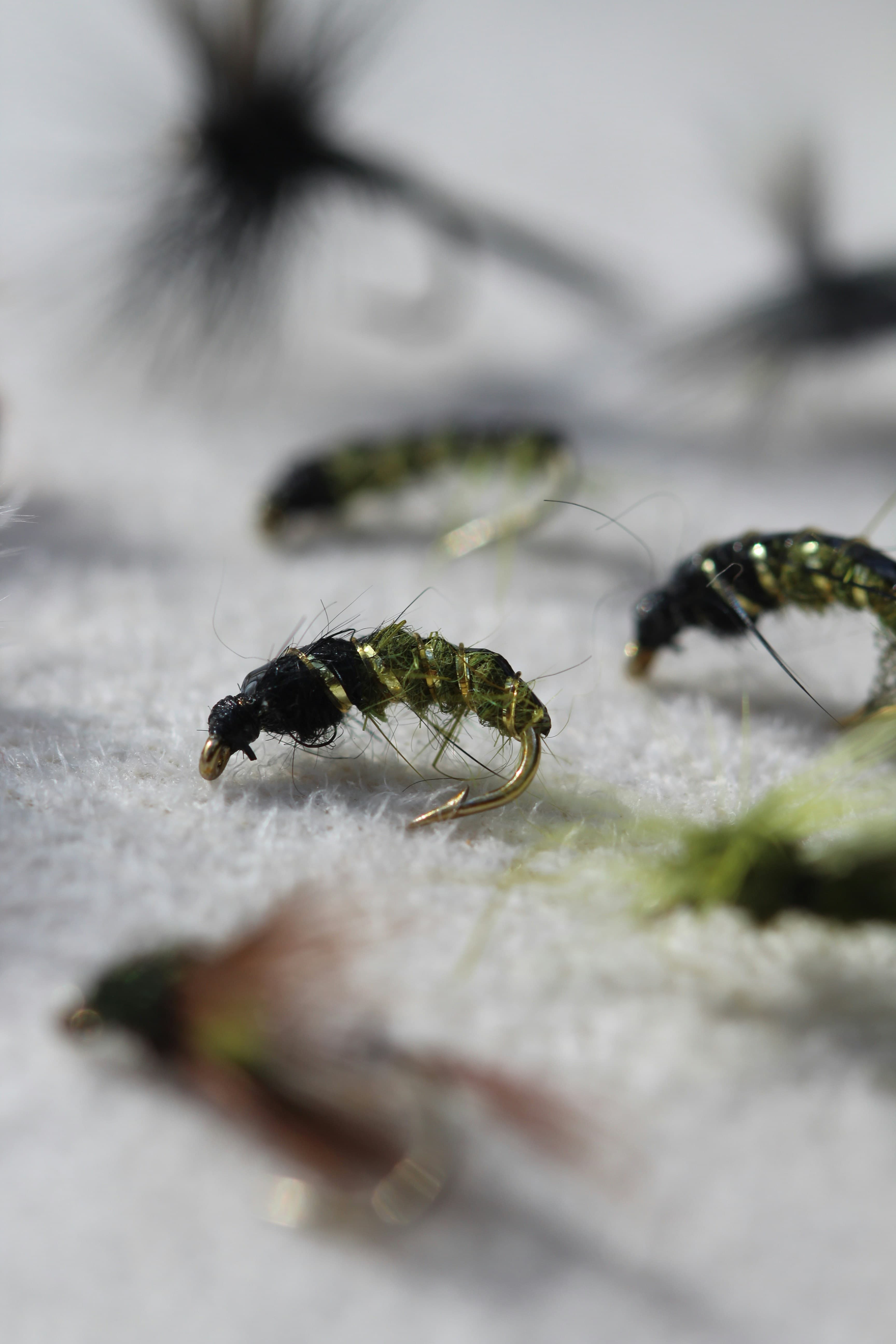
The setup: a ten-to-eleven-foot rod rated two to four weight, with soft action and high modulus for sensitivity. A twelve-to-fifteen-foot level nylon leader in the range of point-zero-one-two to point-zero-one-six inches diameter, carrying two to three weighted nymphs on tag droppers. The flies are heavy Czech nymphs — tungsten bead or lead wire underbody, bent shank, latex back, size ten to sixteen — profiled to imitate shrimp and caseless caddis larvae. The point fly is the heaviest. The droppers are progressively lighter.
The technique: cast the team twenty to forty feet upstream with a high-stick wrist snap — the rod stays overhead, the arm outstretched. Track the flies downstream, keeping the rod tip one to two feet above the water and maintaining constant bottom contact. The flies bounce along the riverbed through the feeding zone. A take registers as a hesitation, a twitch, or a stop in the drift. Lift the rod instantly to ten or eleven o'clock. Do not strip-strike.
Czech nymphing kills in fast pocket water — boulders, plunge pools, two to six feet deep — where indicator rigs cannot reach the bottom and the trout feed in the seams and eddies behind rocks. The method puts the fly where the fish are, at the depth they are feeding, and tells you the moment something intercepts it.
French Leader: Long-Line Stealth Nymphing
Extended range, extreme finesse, and a sighter section that reads takes like a seismograph.
The French leader technique evolved from the 1970s French competition teams, extending the Czech concept for greater range and stealth. Where Czech nymphing operates at ten to thirty feet, the French leader reaches thirty to sixty feet — doubling the effective range while maintaining direct contact.
The setup: a ten-and-a-half to twelve-foot rod rated two to three and a half weight, with progressive flex. The leader is the system: eighteen to twenty-five feet of tapered nylon, running from a point-zero-one-eight-inch butt through an eight-foot taper to point-zero-one-two inches, then a three-foot sighter section in pink or orange high-visibility nylon, and finally three to five feet of fine tippet at point-zero-one-zero to point-zero-zero-eight inches. The flies are lighter than Czech patterns — quartz caddis, perdigons, sizes fourteen to twenty — with the point fly carrying the most weight.
The technique: roll or Spey cast to eliminate aerial loops and maintain stealth. The leader turns over alone — no fly line touches the water. The sighter section tracks takes: a line stop, a quiver, an unexpected movement. Hold the rod high with the elbow low, tracking sixty degrees downstream, mending constantly to maintain a dead drift. The fine tippets — down to one-point-two-pound breaking strain — fool pressured fish that have refused everything else.
The French advantage over Czech: sighter sensitivity combined with distance. On big rivers and smooth glides where Czech nymphing cannot reach without spooking the fish, the French leader delivers flies at range with a delicacy that the trout cannot distinguish from a natural drift.
The Modern Hybrid: Competition Evolution
Czech gave short-range power, French gave distance finesse, competitions fused them into a unified system.
Modern Euro nymphing is not a single method but a spectrum — a toolkit that the angler assembles based on the water in front of them. The competition circuit, where Polish, Spanish, and Czech influences have cross-pollinated for decades, has produced a hybrid approach that takes the best of each tradition and discards the dogma.
Czech nymphing serves fast water and short range with heavy flies. French leader serves distance and stealth with lighter patterns. The Polish hybrid adds indicator elements to the sighter system for tracking takes in complex currents. The Spanish contribution is the perdigon — a slim, tungsten-loaded torpedo that sinks like a stone and fishes through water columns that conventional nymphs cannot reach.
The unified system: a rod of ten-foot-six to eleven-foot-six, rated two to three and a half weight. A leader of fifteen to twenty-two feet, tapering from a point-zero-one-eight-inch butt through a sighter section to point-zero-one-zero-inch tippet. Two to three flies, point heaviest — perdigon or hot-collar nymph — with lighter patterns on the droppers. The method adapts to the water: high-stick in pocket water, extended drift in glides, distance cast in broad runs. One system, infinite applications.
Reading Water for Euro Nymphing
The trout live in the bottom six to eighteen inches. Everything about this method exists to reach them there.
Reading water for Euro nymphing is reading water with a vertical bias. The question is not "where are the trout?" — you can answer that on any freestone river by finding the current seams, the pocket water behind boulders, and the tail-outs where the flow concentrates food. The question is "how deep are they feeding, and how fast is the current moving at that depth?" Because the answer to those two questions determines your fly weight, your leader length, and your approach angle.
Fast pocket water is Czech heaven: boulders creating eddies, plunge pools, two to six feet deep with broken surface that hides the angler. Fish the seams where fast water meets slow, bouncing heavy nymphs along the bottom. Riffle-to-run transitions — the smooth water at the bottom of a riffle where it deepens into a run — are French leader territory: four to eight feet deep, requiring range and subtlety. Tail-outs and glides are the competition endgame: subtle currents, microdrifts, pressured fish that require the lightest flies and the finest tippets.
In all cases, the target zone is the bottom six to eighteen inches of the water column. The flies must reach that zone within seconds of landing and stay there through the drift. If the sighter shows the flies drifting too high — an upward movement rather than a downstream track — add weight. Tungsten putty, twelve inches above the point fly, adjusts depth without changing the fly. The bottom is where the fish are. Get there.
Flies: Slim, Heavy, High-Contrast
The point fly sinks. The droppers suggest. The hot collar triggers.
Euro nymphing flies are designed for function, not beauty. Czech nymphs: bent shank hooks, lead wire or tungsten bead underbody, latex back, dubbing in natural shades — olive, tan, pink. Size twelve to sixteen. These imitate shrimp and caseless caddis larvae, and the bent profile matches the natural curl of a dislodged invertebrate tumbling along the riverbed.
Perdigons: the Spanish contribution that has become universal. Slim bodies of thread or tinsel over a tungsten bead, coated in UV resin for a smooth, fast-sinking profile. Size fourteen to twenty. Hot-spot bead or collar in orange, pink, or chartreuse. The perdigon does not imitate any specific insect. It sinks fast, presents a high-contrast trigger point, and provokes takes from trout that are feeding on anything small and moving near the bottom.
Quartz caddis: pearl mylar body over a tungsten bead, size fourteen to eighteen. A searching pattern that suggests emerging caddis. Tag dropper nymphs: hot-pink-collared patterns that serve as both attractor and visual reference for the angler tracking the drift.
The team builds around a rule: point fly is the heaviest, providing anchor and depth. Droppers at twelve to eighteen inches above, progressively lighter, fishing higher in the water column. Change the point fly to adjust depth. Change the droppers to adjust the profile. Depth first, pattern second — the same principle that governs all subsurface fishing.
Leader Construction: The Turnover Code
The leader is the system. Without the right taper, the method does not work.
Czech leader — short and steep: twelve feet of level nylon at point-zero-one-four inches. Tag droppers of twelve inches in point-zero-one-two inches for the dropper flies. Point fly on the end, carrying the heaviest nymph. No taper, no sighter — the leader is short enough that the rod tip acts as the indicator. This is the simplest setup and the fastest to rig.
French leader — long and tapered: eight feet of butt section at point-zero-one-eight inches, tapering through eight feet to point-zero-one-two inches. Three feet of sighter in pink or orange high-visibility nylon at point-zero-one-two inches. Three to five feet of tippet at point-zero-one-zero inches. The taper turns the leader over on the roll cast, the sighter tracks the drift, and the fine tippet presents the fly without disturbance.
Fine-tuning: add one to two millimetres of tungsten putty twelve inches above the point fly for depth control without changing the fly. Shorten the tippet section in fast water for better contact. Lengthen it in slow water for stealth. The leader is not a fixed formula — it is a system that the angler adjusts to each piece of water.
Reading the Take: Ten Times Indicator Sensitivity
A hesitation in the sighter that lasts a quarter of a second — that is a trout.
The reason Euro nymphing catches more fish than indicator nymphing is not the flies or the depth — it is the takes you detect. An indicator rig absorbs and dampens the signal. A buoyant indicator must be pulled under before it registers, and by the time it moves, the trout has often felt the resistance and ejected the fly. The Euro nymphing sighter transmits the take directly: a hesitation, a twitch, a stop, a sideways drift. Movements that last a fraction of a second and would be invisible on an indicator rig.
A hesitation in the sighter: the trout has mouthed the fly and is testing it. Lift immediately — the window is a quarter of a second at most. A sharp twitch or jerk: an aggressive grab, a committed take. Lift. A stop: the fly has hit bottom or a rock — or a trout has intercepted it on the drop. Lift anyway. If it is a rock, you lose nothing. If it is a fish, you lose it by waiting. An upward drift of the sighter: the flies are too light for the current and riding above the feeding zone.
Set the hook by lifting the rod to ten or eleven o'clock, angled upstream at forty-five degrees. Never strip-strike downstream — the angle pulls the fly out of the trout's mouth. The lift drives the hook point into the upper jaw. This is the same principle as the traditional wet-fly lift, adapted for tight-line contact. The take is subtle. The response must be instant.
Tackle: Competition Specification
An eleven-foot three-weight, a leader, and nothing else on the water.
Rod: eleven feet, rated three weight. This is the balance point between casting power and take detection — long enough to control the drift at range, light enough to register the subtlest contact. Competition models from specialist manufacturers are designed specifically for this purpose, with high-modulus blanks that transmit information from the fly to the hand without delay.
Reel: large arbor, rated three. The reel's primary function in Euro nymphing is to store backing and the fly line that you will not use. Capacity is irrelevant. Balance with the rod is everything.
Line: none on the water. The fly line stays on the reel. Only the leader — monofilament, sighter, and tippet — touches the river. This eliminates drag, eliminates surface disturbance, and creates the direct connection between rod tip and fly that the entire system depends on.
Accessories: forceps for pinching barbs, spools of tippet in point-zero-one-zero and point-zero-one-two millimetre, tungsten putty for depth adjustment. The kit is minimal because the method is minimal. One rod, one leader system, a box of nymphs, and the river. Everything else is overhead.
Matching Method to Water
Pocket water: Czech. Riffle-to-run: French. Tail-out: go light and pray.
Pocket water — boulders, broken current, two to six feet deep: Czech setup. Short range, heavy flies, high-stick tracking. The broken surface hides the angler and the heavy nymphs reach the bottom within seconds. This is the bread-and-butter water for the method.
Riffle-to-run transitions — four to eight feet, moderate current: French leader. The range advantage matters here — the fish hold further from the bank, and the stealth of a long leader presentation avoids the spooking that a short-line approach would cause. Medium-weight flies, extended drift.
Tail-outs and glides — smooth, shallow, pressured fish: Polish hybrid or pure French with the lightest flies and the finest tippet. This is the most demanding water. The fish can see everything, the current is subtle, and the takes are the softest of all. Go light, go fine, and concentrate on the sighter as though your life depends on it.
Your Euro Nymphing Day
Assess the water, rig for the depth, fish the sighter, rotate every fifteen minutes.
Assess: stand back and read the water before rigging. Fast pocket water demands the Czech setup — heavy point fly, short leader. Smooth glides demand the French leader — long taper, fine tippet, lighter nymphs. Mixed water demands the ability to switch between the two, which means carrying a spare leader or building a versatile hybrid that serves both.
Rig: match fly weight to depth and flow. The point fly must reach the bottom within two to three seconds of landing. If it does not, it is too light. Add tungsten putty above the point fly in small increments until you feel the bottom consistently. The droppers fish higher in the column — they do not need to touch the bottom.
Fish: high stick, constant contact, lift every sighter tick. Cover the water systematically — fan casts through a run, a step between each, working upstream. Every piece of holding water gets three to five drifts before you move on.
Rotate: if fifteen minutes produce no takes, change. Not the spot — the depth. Add weight to the point, or swap the dropper pattern, or lengthen the tippet. Change one variable at a time. If the water is genuinely empty, move to the next run. Euro nymphing rewards persistence and punishes stubbornness in equal measure.