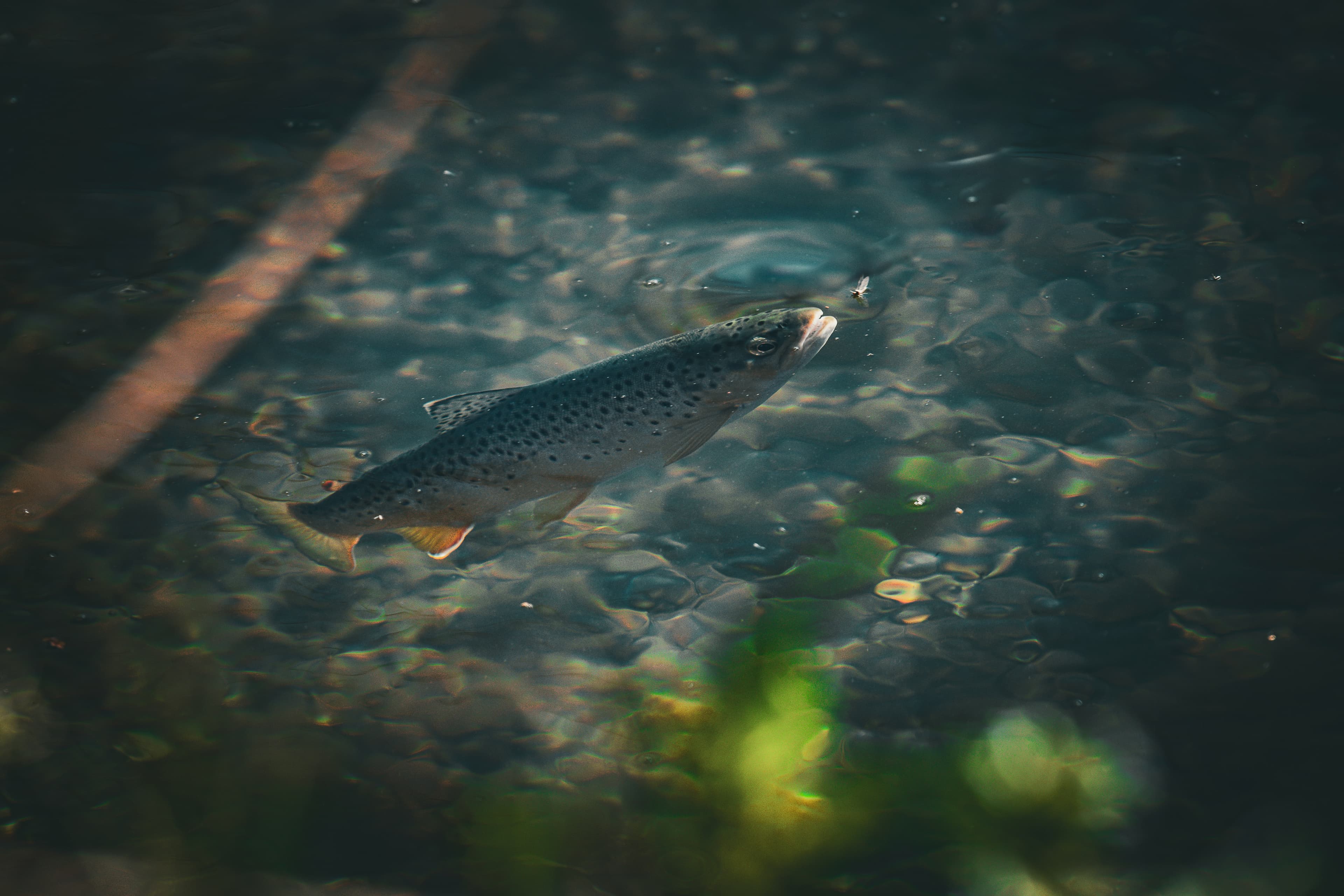
Yorkshire River DNA
Peat-stained, rocky, spate-driven, cutting through limestone scars and heather moors — these rivers wrote the rules before anyone thought to codify them.
Yorkshire's rivers are freestone in the purest sense: fast, rocky, coloured by peat, driven by rain, and entirely indifferent to your schedule. The Swale, the Ure, the Wharfe, the Ribble, the Cover, the Nidd — they cut through limestone scars and heather moors with a particular urgency, and the trout that live in them have adapted to a world where the water level can rise two feet overnight and drop back by lunchtime. Stable chalkstream hatches? Forget them. Here, the olives, the needle flies, and the terrestrials appear when they damn well please, and the fish are ready for them or they are not.
Wild brown trout rule these rivers — small, fierce, fin-perfect fish that average eight to twelve ounces and fight like something considerably larger. Two-pound specimens exist, holding in the deeper pools and under the limestone ledges, and they are the kind of fish that makes you question whether you really tied that knot properly. Grayling share the water, particularly in the autumn and winter, feeding in the tail-outs and glides with the quiet concentration of fish that know exactly what they are doing.
This is North Country spider country. The sparse soft-hackle wet flies that were born on these rivers — centuries before Halford thought to tell everyone else how to fish — are still the most effective patterns in the box. The tradition is older, simpler, and more honest than the chalkstream orthodoxy that came later, and it works because the rivers have not changed. The limestone is still there. The peat water still runs. The trout still grab a well-swung spider like their ancestors did in Pritt's day.
North Country Spiders: Two Hundred Years of Yorkshire DNA
Silk body, sparse hackle, no wings — suggestion, not imitation. The fly that triggers instinct.
The North Country spider is the oldest continuously fished fly pattern in the English-speaking world, and it endures because it does something that more elaborate flies often fail to do: it looks alive in the water. A silk body — Pearsall's gossamer, the colour of whatever you are imitating — and one or two turns of partridge or waterhen hackle. No wings. No flash. Nothing superfluous. The hackle breathes in the current, pulsing and collapsing with each change of flow, and the trout cannot help themselves. It triggers the instinctive grab that a precise imitation sometimes fails to provoke.
T.E. Pritt codified the tradition in his 1885 Yorkshire Trout Flies, but the flies themselves had been fished for centuries before that. The principle is suggestion rather than imitation — the spider does not look exactly like any single insect, but it looks enough like all of them to convince a trout that has a fraction of a second to decide.
The core Yorkshire team, on size fourteen to sixteen hooks: March Brown Spider on the point — hare's ear body with brown partridge hackle, the all-season killer that searches water and catches fish in every month of the year. Waterhen Bloa on the top dropper — mole fur body with waterhen hackle, a deadly imitation of the large dark olive nymph at the point of emergence. Partridge and Orange in the middle — orange silk body with grey partridge hackle, suggesting stonefly nymphs and a dozen other subsurface foods. Tie them sparse. A fat spider is a river trout repellent.
Fishing the Swing: The Across-and-Down Masterclass
High rod, forty-five degrees across, let the current do the work. The method strips fly fishing to its essence.
The core method: hold the rod at thirty degrees above horizontal, cast forty-five degrees across and slightly downstream. Let the current swing the flies in a quarter-circle arc below you, the line bellying gently in the flow. Short line — ten to twelve yards. The slack between rod tip and fly absorbs the take. The flies move from dead drift through the swing into the induced take as the current tightens the line at the end of the arc.
Upstream variation: tight-line, Euro-nymph style, the March Brown on the point bouncing through rubble runs with direct contact to the flies. This is the method for fast, broken water where the across-and-down swing cannot hold depth. Downstream trot: for low, clear water when the fish are spooky — a long leader, a slow swing, and the patience to let the current present the flies without interference.
Retrieve: none. Let the current work. At the end of the swing, when the line has straightened below you, twitch the rod tip — a single, short movement that accelerates the flies and triggers slashing takes from fish that have followed without committing. The take feels like a handshake: the line tightens with a deliberate pull, and you lift the rod. Do not strip-strike. The lift sets the hook. On these rivers, it always has.
Reading Yorkshire Water
Rubble runs, limestone ledges, tail-outs, and the dippers that show you where to cast.
Yorkshire freestone water reads like freestone water everywhere, with the addition of limestone features that create lies you would not find on a granite river. The heads of riffles trap nymphs in the turbulence — dead-drift a spider upstream through the broken water and let the current bounce it along the bottom. Undercut limestone ledges shelter the bigger trout, ambush predators that dart out to intercept food drifting past the edge of the current. Swing your team below the ledge and let the flies arc into the zone where the trout expects its dinner to arrive.
Tail-outs are grayling territory. The smooth, accelerating water at the bottom of a pool concentrates food into a narrow band, and the grayling hold there in groups, tipping up to intercept nymphs with a precision that trout rarely match. Across and down, Partridge and Orange on the point, and you are fishing the most reliable grayling method in the north of England.
After a spate, fish the first clean lies — the rubble margins where fresh water runs fastest and the silt has been flushed. The fish move back into these lies as soon as the water begins to clear, and the first angler to find them after a flood has an advantage that lasts exactly as long as it takes everyone else to work it out. Watch for dippers — the small, dark birds that bob on rocks in the fastest water. They are feeding on the same invertebrates as the trout, and they are easier to spot from thirty yards.
Seasons: Spiders Beat Hatches
March spates and olive hatches, summer dusk swings under the alders, autumn grayling in the tail-outs.
March through May is the heart of the Yorkshire trout season. Spates flush food through the system, the olive hatches begin in earnest, and the fish are willing — newly emerged from the torpor of winter and hungry enough to take a well-presented spider without excessive deliberation. Waterhen Bloa and Partridge and Orange on the team, fished through the runs and riffles where the trout hold in the broken water. This is when the rivers are at their most generous.
June through August brings low water and educated trout. The hatches thin to terrestrials — black gnats, hawthorn flies, the occasional sedge at dusk — and the fish retreat into deeper lies where the current provides cover. Evening is the time. A full spider team swung slowly under overhanging alders as the light drops produces the best fish of the summer. March Brown and Black and Peacock on the team, size sixteen, fished with the patience that low water demands.
September through November belongs to the grayling. The water cools, the trout become less active, and the grayling come into their own — feeding in the tail-outs and glides with an appetite that increases as the temperature drops. Partridge and Orange with Waterhen Bloa, dead-drifted through the smooth water, is the classic autumn combination. Grayling fight differently from trout — broad-sided in the current, using the flow rather than fighting against it — and a fourteen-inch grayling on a four-weight rod in a Yorkshire dale is fishing at its most essential.
Low-water killer across all seasons: extend the leader to fifteen feet, drop to size sixteen, and fish the spider team upstream rather than across. The presentation is gentler, the drift is longer, and the spooky fish that refuse the swung fly will sometimes take the dead-drifted spider as though it were a different proposition entirely.
Tackle: Light, Simple, Yorkshire
A nine-foot four-weight, a floating line, three spiders on eighteen-inch spacing. Nothing more is needed.
Rod: nine feet, rated four or five weight. The delicacy matters — the swing requires a rod that loads at short range and presents the team of flies without disturbance. A ten-foot six-weight earns its place in spate conditions when the extra length controls line in heavy current, but for normal water the lighter rod is the better tool.
Line: weight-forward floating. Leaders of twelve to fifteen feet, four-to-six-X tippet. The team of three flies is spaced at eighteen to twenty-four inches — close enough to fish as a unit, far enough apart to avoid tangling on the cast. Barbless hooks throughout. These are wild fish on fragile water, and barbless is not optional.
The entire outfit fits in a shoulder bag. There is no need for a vest full of boxes, a landing net the size of a tennis racket, or any of the paraphernalia that the tackle industry insists you require. A box of spiders, a spool of tippet, a pair of forceps, and the river. Yorkshire fly fishing is simple because the fishing demands it, and the simplicity is part of the point.
The Grayling Bonus: Winter Spider Heaven
Cold, clear tail-outs, a Partridge and Orange dead-drifted through the glide — and a fish that outfights trout two to one.
Yorkshire grayling are the bonus that the Dales rivers offer after the trout season closes, and they are a bonus worth planning a trip around. Eight to sixteen inches of silver and purple, holding in the tail-outs and smooth glides where the current concentrates food, feeding through the coldest months with an enthusiasm that trout abandoned weeks ago.
The method is unchanged from the trout season: Partridge and Orange and Waterhen Bloa, dead-drifted or gently swung through the feeding lanes. The grayling takes differently from a trout — a subtle draw on the line, a momentary hesitation in the drift, sometimes nothing more than the leader straightening when it should not. Lift into it. The fight that follows will surprise you. Grayling use the current like a sail, turning broadside and riding the flow with a stubbornness that fish of their size should not possess. A good grayling on a light rod in cold water is one of the pleasures of British fishing that too few anglers discover.
Catch and release matters more with grayling than with most fish. They are sensitive to handling, slow to recover in cold water, and their populations in some Yorkshire rivers are more fragile than they appear. Barbless hooks, wet hands, minimal time out of the water. The fish you release into the tail-out today is the fish that will be there when you come back in January.
Conservation: Dales Wild Browns
Wild populations, fragile water, and the responsibility that comes with fishing rivers that have never been stocked.
The wild brown trout of the Yorkshire Dales have never been stocked. They breed in the feeder burns, grow in the main river, and sustain themselves without human intervention — provided the habitat remains. This is not something to take for granted. Agricultural run-off, gravel extraction, and poorly managed land drainage have degraded stretches of river that were productive a generation ago.
Catch and release is the policy on most Dales beats, and it should be the practice on all of them. Barbless hooks are mandatory. No worm, no floating bait, no stocking — the beats that maintain these rules are the beats that still hold wild fish. Support them. The day ticket costs ten to twenty pounds, which is the price of a mediocre lunch and a bargain for a day on water that holds fin-perfect wild browns in a landscape that Pritt would still recognise.
Your Yorkshire Day
Dawn riffles, midday dropper changes, dusk swings under the alders — the rhythm of a Dales river.
Dawn: March Brown Spider on the point, Waterhen Bloa and Partridge and Orange on the droppers. Start at the bottom of the beat and work upstream, fishing each riffle and run with upstream dead-drifts through the broken water. Short casts, tight line, direct contact with the flies. The early fish are in the fast water, feeding on nymphs dislodged by the current overnight.
Midday: if takes slow, change the dropper order — Partridge and Orange to the top position, Black and Peacock in the middle. Fish the across-and-down swing through the deeper runs and under the limestone ledges. Vary the angle — forty-five degrees to start, steeper if the fish want the fly moving faster, shallower if they want it slower. The river tells you what it needs.
Dusk: the full team, fished on a slow swing under overhanging alders and through the tail-outs as the light drops. This is the hour when the bigger trout feed with confidence, and the spider team comes into its own — three flies covering three depths, the current presenting them with a life that no retrieve can match. The last fish of the evening, taken on the swing in fading light, is the one you will remember.